
STIX and TAXII: Standardizing Threat Intelligence Exchange
Structured data formats prevent intelligence decay and enable automated response actions that raw text reports cannot support.
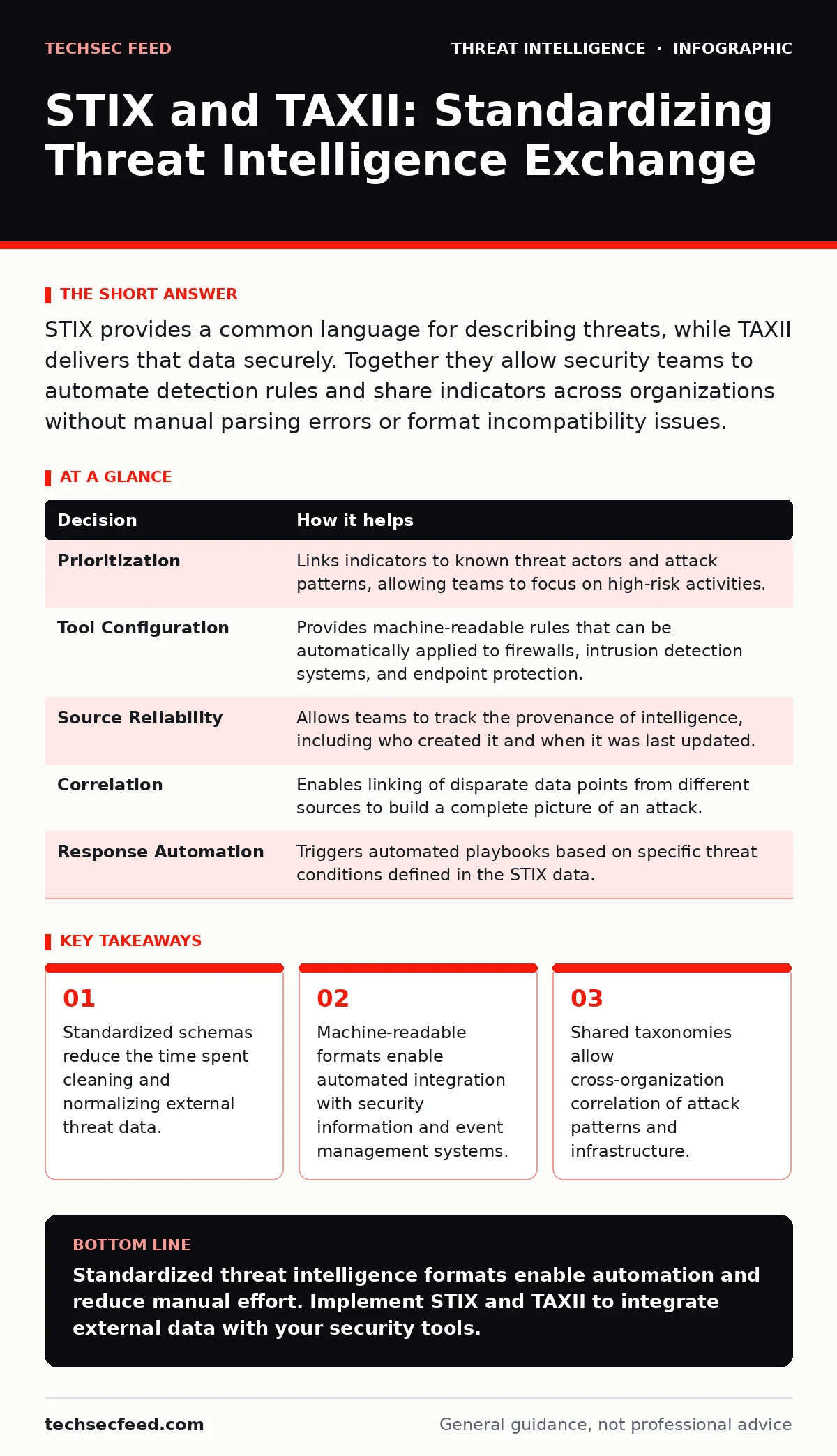
STIX provides a common language for describing threats, while TAXII delivers that data securely. Together they allow security teams to automate detection rules and share indicators across organizations without manual parsing errors or format incompatibility issues.
The Problem With Unstructured Threat Data
Security teams receive intelligence in many formats. Emails, PDF reports, and raw text files are common. These formats require manual effort to extract useful indicators. Analysts must read the document, identify the relevant details, and enter them into their security tools. This process is slow and prone to human error. A typo in an indicator can block legitimate traffic. A missed detail can leave a vulnerability open. Unstructured data also lacks context. It does not explain how an indicator relates to other threats or what specific attack behavior it represents. This lack of context limits the ability to correlate events across different systems.
Imagine a team receiving a PDF about a new malware strain. The analyst copies the file hashes into a firewall rule. Hours later, another analyst sees a network alert related to the same malware. They do not recognize the connection because the network alert uses a different identifier. The team fails to link the file hash to the network activity. This delay allows the attacker to move laterally within the network. Structured data solves this by linking all related indicators under a single, machine-readable object.
What STIX Actually Does
STIX is a structured information eXchange standard. It defines a common language for describing cyber threats. It uses JSON or XML to represent objects like indicators, malware, attack patterns, and threat actors. Each object has a unique identifier and a set of properties. This structure allows computers to parse and understand the data without human intervention. STIX also defines relationships between objects. For example, an indicator can be linked to a specific malware family. This relationship provides context that raw indicators lack. It tells the system not just what to block, but why.
The standard supports different types of indicators. You can define indicators based on file hashes, IP addresses, domain names, or URLs. You can also define complex indicators based on multiple conditions. This flexibility allows teams to share detailed detection logic. However, STIX is only a format. It does not specify how to transfer the data. It is a container for information, not a delivery mechanism. Teams must choose a method to move STIX data between systems.
How TAXII Enables Distribution
TAXII is the Trusted Automated eXchange of Intelligence Information protocol. It defines how to share STIX data over networks. It uses HTTP and HTTPS to transmit data securely. TAXII supports several types of services. Collection services allow you to store and retrieve STIX data. Discovery services help you find available collections. Management services handle user authentication and authorization. This separation of concerns makes it easy to build systems that can both send and receive intelligence.
TAXII supports both push and pull models. In a push model, a provider sends data to a consumer when new intelligence is available. This reduces latency and ensures consumers have the latest data. In a pull model, a consumer requests data from a provider at regular intervals. This gives consumers more control over when they receive updates. Most modern implementations support both methods. This flexibility allows teams to design architectures that fit their operational needs.
Decisions Informed By Structured Intelligence
Structured intelligence informs several critical operational decisions. It helps teams prioritize which threats to investigate first. It guides the configuration of security tools. It determines which data sources are reliable. The following table shows how STIX and TAXII support these decisions.
| Decision | How it helps |
|---|---|
| Prioritization | Links indicators to known threat actors and attack patterns, allowing teams to focus on high-risk activities. |
| Tool Configuration | Provides machine-readable rules that can be automatically applied to firewalls, intrusion detection systems, and endpoint protection. |
| Source Reliability | Allows teams to track the provenance of intelligence, including who created it and when it was last updated. |
| Correlation | Enables linking of disparate data points from different sources to build a complete picture of an attack. |
| Response Automation | Triggers automated playbooks based on specific threat conditions defined in the STIX data. |
What Goes Wrong Without Standards
Without standardized formats, teams struggle with data silos. Each vendor uses its own proprietary format. Integrating data from multiple sources requires custom parsers and adapters. These adapters break when vendors update their formats. Maintenance costs rise as teams spend more time fixing integrations than analyzing threats. Inconsistencies in data representation lead to missed detections. One system might use IPv4 addresses while another uses IPv6. Another might use fully qualified domain names while another uses hostnames.
Imagine a team that receives intelligence from two different providers. One provider uses a custom JSON format. The other uses CSV files. The team builds separate scripts to parse each format. When Provider A changes its JSON structure, the script breaks. The team does not notice for days. During this time, critical indicators are not loaded into the security tools. This gap allows attackers to operate undetected. Standardization prevents these fragile integrations by providing a single, stable format.
See also: Pass-the-Hash Prevention: Stop Credential Theft Without NTLMv2 · How the MITRE ATT&CK Navigator Maps Tactics to Detection
How Teams Use STIX and TAXII
Teams use STIX and TAXII to automate their threat intelligence workflows. They subscribe to TAXII servers that provide curated intelligence. These servers push new indicators to the team’s security information and event management system. The SIEM automatically creates detection rules based on the incoming data. This reduces the time between threat discovery and protection. Teams also use STIX to share intelligence with other organizations. They contribute their own findings to industry sharing groups. This reciprocal sharing improves the collective defense posture.
For example, a team might detect a new command and control traffic pattern. They create a STIX object describing the pattern and the associated indicators. They publish this object to their TAXII server. Other teams subscribing to this server receive the data and automatically update their detection rules. This rapid sharing helps contain the threat before it spreads widely. Teams can also use STIX to document their own internal threat models. This helps new analysts understand the specific risks facing their organization.
Integrating With Other Security Controls
Structured intelligence works best when integrated with other security controls. It complements tools that monitor system activity. For instance, data about scheduled task abuse can be enriched with STIX indicators. If an attacker uses a scheduled task to persist, the associated indicators can help detect this behavior. Similarly, intelligence about pass-the-hash attacks can inform detection rules for authentication anomalies. Teams can also use STIX to track autonomous system numbers (ASNs) in threat intelligence. This helps identify malicious infrastructure at the network level.
Canary tokens can be placed in sensitive areas. If a token is triggered, the associated STIX data can help identify the attacker. This data can then be shared with other teams via TAXII. Sysmon logs can be correlated with STIX indicators to detect early stages of an attack. For example, if Sysmon detects a process creating a new service, the STIX data can help determine if this is part of a known attack pattern. This integration creates a more defensive environment.
Maintaining Data Quality
Data quality is critical for effective threat intelligence. Stale indicators can clutter security tools and reduce their effectiveness. Teams must regularly review and update their STIX data. They should remove indicators that are no longer relevant. They should also update the relationships between objects as new information becomes available. This maintenance ensures that the intelligence remains accurate and useful. Automation can help with this process. Scripts can flag old indicators for review. Teams can also use TAXII to synchronize their data with trusted sources.
Teams should also monitor the performance of their detections. If a detection rule generates too many false positives, it may need adjustment. The STIX data can help identify which indicators are causing the noise. By refining the data, teams can improve the accuracy of their detections. This continuous improvement process ensures that the intelligence remains a valuable asset.
Key takeaways
- Standardized schemas reduce the time spent cleaning and normalizing external threat data.
- Machine-readable formats enable automated integration with security information and event management systems.
- Shared taxonomies allow cross-organization correlation of attack patterns and infrastructure.
Standardized threat intelligence formats enable automation and reduce manual effort. Implement STIX and TAXII to integrate external data with your security tools.
Frequently asked questions
How do I start using STIX and TAXII?
Identify a trusted intelligence provider that supports TAXII. Configure your security tools to subscribe to their TAXII server. Map the incoming STIX objects to your detection rules.
Is STIX only for large organizations?
No. Small teams can also benefit from standardized formats. They reduce the complexity of integrating multiple data sources and improve the accuracy of detections.
Can I use STIX for internal threat data?
Yes. You can use STIX to document internal threat models and share findings within your organization. This helps align different teams on common threat terminology.
How does STIX handle sensitive information?
STIX supports metadata to indicate sensitivity levels. Teams can use encryption and access controls to protect sensitive data during transmission and storage.
How this guide was produced: written by the TechSec Feed editorial team with AI assistance, checked against the public references listed below, and reviewed when the facts change. See our editorial policy or report an error.