
Data Subject Access Requests: Mechanism, Limits and Hidden Costs
Processing access requests reveals that data fragmentation and legacy storage systems create operational bottlenecks far greater than the legal requirement itself.
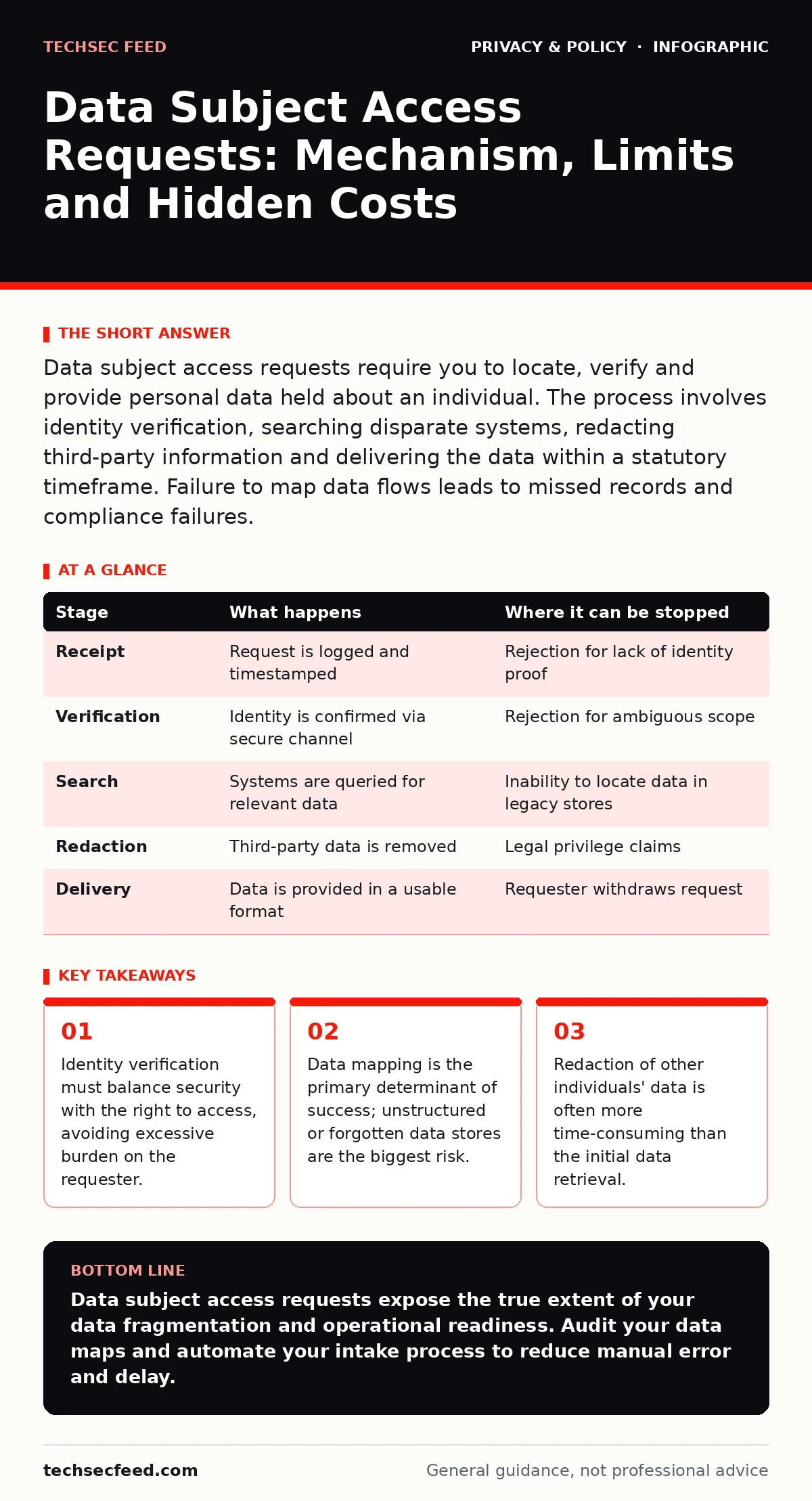
Data subject access requests require you to locate, verify and provide personal data held about an individual. The process involves identity verification, searching disparate systems, redacting third-party information and delivering the data within a statutory timeframe. Failure to map data flows leads to missed records and compliance failures.
The Legal Trigger and Scope
A data subject access request allows an individual to obtain a copy of the personal data you hold about them. This mechanism exists in frameworks like GDPR, CCPA and others. It is not a fishing expedition. You are not required to create new data or provide opinions. You provide existing records.
The scope includes automated decision-making logic and profiling. It excludes data required for legal privilege or ongoing law enforcement investigations. You must determine if the request is manifestly unfounded or excessive. This determination requires documentation.
Stage 1: Receipt and Acknowledgement
The clock starts when you receive the request. There is no standard format. A request can be an email, a web form or a letter. You must acknowledge receipt. This acknowledgement confirms you have received the inquiry and are processing it.
You do not need to confirm the content yet. You confirm the administrative act of receiving. Some jurisdictions allow a one-month extension for complex requests. You must notify the requester of this extension within the initial timeframe.
| Stage | What happens | Where it can be stopped |
|---|---|---|
| Receipt | Request is logged and timestamped | Rejection for lack of identity proof |
| Verification | Identity is confirmed via secure channel | Rejection for ambiguous scope |
| Search | Systems are queried for relevant data | Inability to locate data in legacy stores |
| Redaction | Third-party data is removed | Legal privilege claims |
| Delivery | Data is provided in a usable format | Requester withdraws request |
Stage 2: Identity Verification
You must verify the requester is who they claim to be. Sending data to the wrong person is a breach. The verification method must be proportionate. If the user is already authenticated in your system, you may use existing session data.
If the user is not authenticated, you need additional proof. This might involve government ID or specific knowledge questions. Do not ask for more data than necessary. The verification process itself must not compromise the privacy of the data being requested.
Imagine a user requests data via a generic support email. You cannot send the data back to that same email. You must establish a secure channel or verify identity through a secondary method. This step prevents social engineering attacks where attackers impersonate victims.
Stage 3: Data Discovery and Mapping
This is the most resource-intensive stage. You must search all systems containing personal data. This includes CRM platforms, HR databases, email servers and backup tapes. You also need to check unstructured data. File metadata often contains personal identifiers.
Data mapping is critical here. If you do not know where your data lives, you cannot find it. Automated tools can help search structured databases. Unstructured data requires manual review or advanced indexing.
Legacy systems are often disconnected from central directories. Data may exist in exported CSV files or archived emails. These silos are where requests fail. You must have a comprehensive inventory of data stores.
Stage 4: Redaction and Privilege
You cannot provide data that belongs to other individuals. If a customer support ticket contains the name of an employee, you must redact it. If an email chain includes other clients, their data must be removed.
This process is manual and slow. Automated redaction tools exist but are imperfect. They may miss context or over-redact. Human review is often necessary to ensure accuracy. You must balance the right to access with the privacy of others.
Legal privilege may also apply. Attorney-client communications are often exempt. You must identify these exemptions early. Claiming privilege incorrectly can lead to penalties. Document every redaction decision.
See also: Child Identity Theft: Why Small Businesses Are Targets and How to Stop It
Stage 5: Formatting and Delivery
You must provide the data in a commonly used, machine-readable format. JSON or CSV are standard. PDFs are acceptable for human-readable documents. Do not provide raw database dumps. They are unusable and risky.
The delivery method must be secure. Email is generally unsafe for large datasets. Use a secure portal or encrypted file transfer. Provide instructions on how to access the data. Confirm delivery with the requester.
The Hidden Costs and Limits
Processing requests is expensive. It diverts staff from other tasks. The cost is not just labor. It is the risk of error. Missing a record is a compliance failure. Revealing too much is a privacy breach.
There is a limit to how much data you can provide. If the request is excessive, you can charge a fee or refuse. This is rare and requires careful justification. Most organizations choose to comply fully to avoid scrutiny.
The biggest hidden cost is data fragmentation. As you add new tools, you create new silos. Each new tool increases the surface area for future requests. Regular privacy audits help identify these gaps before they become problems.
Operationalizing the Process
You need a standardized workflow. Manual processes fail at scale. Automate the intake and tracking. Use case management software to log every step. Assign ownership to specific teams.
Train staff on the process. They need to recognize requests. They need to know where to route them. Consistency is key. Inconsistent responses lead to legal challenges.
Review your process regularly. Technology changes. Laws change. Your process must adapt. Conduct drills to test your response time. Identify bottlenecks and fix them.
Long-Term Implications
Data subject access requests reveal the state of your data hygiene. If you struggle to find data, your governance is weak. If you struggle to redact, your classification is poor.
These requests are not just legal obligations. They are operational audits. They force you to understand your data. This understanding improves security and privacy. It reduces risk.
Imagine a company that never receives requests. They assume their data is clean. It is not. They simply have not been tested. Proactive testing is better than reactive compliance.
Key takeaways
- Identity verification must balance security with the right to access, avoiding excessive burden on the requester.
- Data mapping is the primary determinant of success; unstructured or forgotten data stores are the biggest risk.
- Redaction of other individuals' data is often more time-consuming than the initial data retrieval.
Data subject access requests expose the true extent of your data fragmentation and operational readiness. Audit your data maps and automate your intake process to reduce manual error and delay.
Frequently asked questions
How long do I have to respond to a request?
Most frameworks require a response within one month. This can be extended by two months for complex cases, with notification to the requester.
Can I charge a fee for processing?
Generally, no. You can charge a reasonable fee for manifestly unfounded or excessive requests, particularly if they are repetitive.
What if the requester is not a customer?
You must still comply if you hold their personal data. This includes website visitors, job applicants and former employees.
Do I need to search deleted data?
No. You are only required to provide data you currently hold. This does not include backups that are not actively restored, unless they are readily accessible.
How this guide was produced: written by the TechSec Feed editorial team with AI assistance, checked against the public references listed below, and reviewed when the facts change. See our editorial policy or report an error.