
Privacy Audits Checklist: Verify Data Flows and Consent
Most privacy failures stem from unrecorded data flows rather than missing consent banners, making data mapping the highest-value audit activity for long-term compliance.
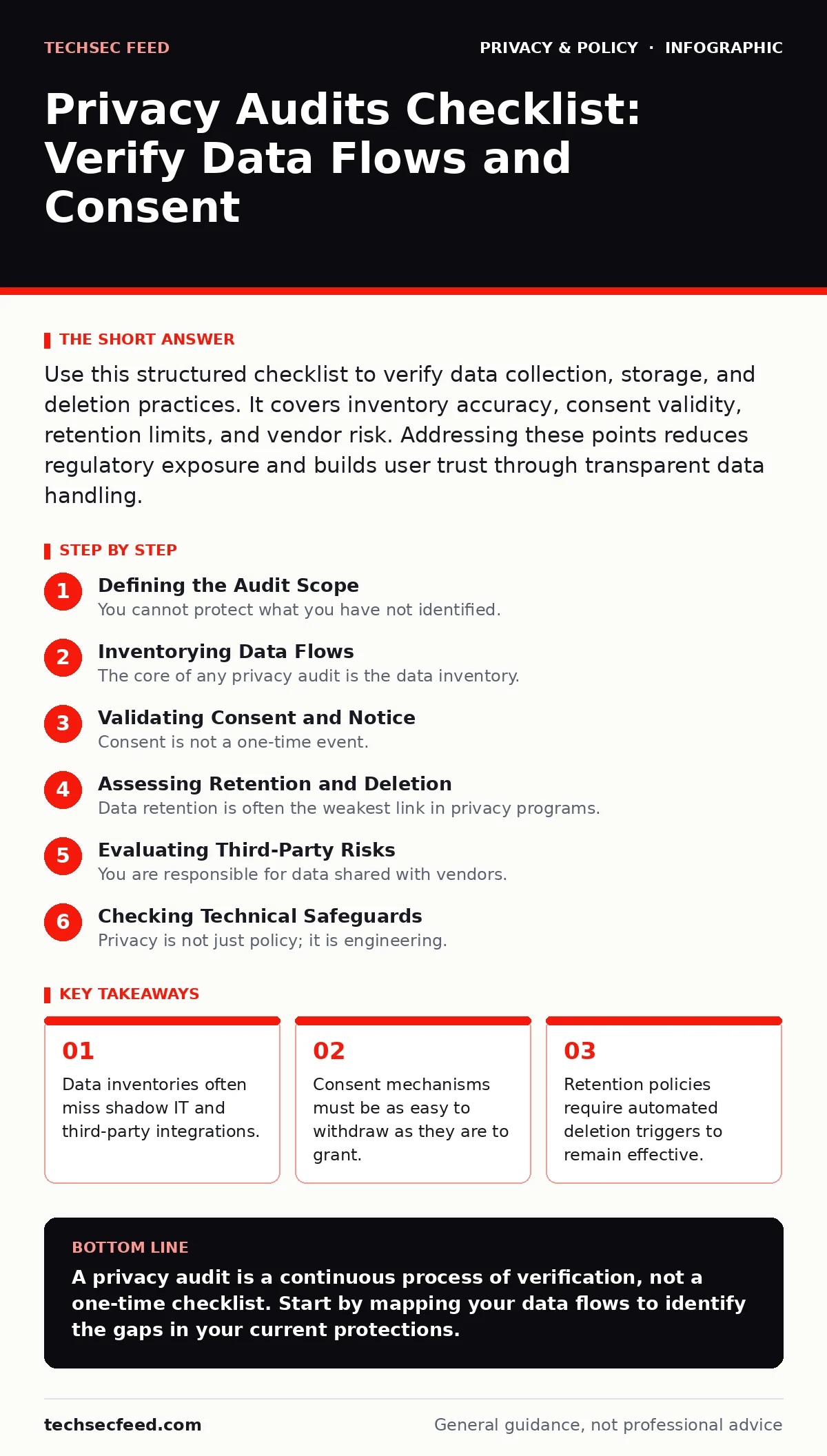
Use this structured checklist to verify data collection, storage, and deletion practices. It covers inventory accuracy, consent validity, retention limits, and vendor risk. Addressing these points reduces regulatory exposure and builds user trust through transparent data handling.
Defining the Audit Scope
You cannot protect what you have not identified. A privacy audit begins with a clear definition of boundaries. Determine which systems, applications, and physical locations fall under review. This scope must include legacy systems that no longer receive active development support.
Suppose your organization uses a cloud storage service for internal documents. That service is part of the scope even if it is not customer-facing. Excluding it creates a blind spot where data leaks can occur without detection.
Inventorying Data Flows
The core of any privacy audit is the data inventory. You must map every entry point where personal data enters your systems. This includes web forms, API calls, and manual data entry by staff. For each data type, record where it is stored and who can access it.
- List all data collection points: Knowing where data enters prevents unauthorized collection.
- Map internal data processing steps: Understanding transformation reveals hidden privacy risks.
- Identify third-party data recipients: External transfers introduce liability outside your direct control.
Many teams focus only on primary databases. They overlook temporary caches, backup logs, and analytics platforms. These secondary stores often retain data longer than intended. Reviewing your consent management practices helps clarify what users agreed to receive.
Validating Consent and Notice
Consent is not a one-time event. It is an ongoing relationship between you and the data subject. Check that your notice mechanisms are clear and accessible. Users must understand what data is collected and why before they agree.
- Verify notice clarity and placement: Ambiguous notices invalidate consent in many jurisdictions.
- Test opt-out and withdrawal mechanisms: Friction in withdrawal suggests non-compliant design patterns.
- Audit pre-ticked boxes and dark patterns: Forced consent is invalid and erodes user trust.
Imagine a user tries to withdraw consent for marketing emails. If the process requires multiple clicks or phone calls, the mechanism fails. The withdrawal path must be as simple as the acceptance path. This aligns with broader efforts to manage data subject access requests efficiently.
Assessing Retention and Deletion
Data retention is often the weakest link in privacy programs. Keeping data longer than necessary increases the impact of a breach. You must define specific retention periods for each data category. These periods should be based on legal requirements or business necessity, not convenience.
- Document retention schedules for each data type: Clear limits prevent indefinite data hoarding.
- Verify automated deletion triggers: Manual deletion is prone to human error and oversight.
- Check backup and archive policies: Restoring old backups can resurrect deleted data unexpectedly.
Consider a customer who requests account deletion. If their data remains in a dormant backup for years, you have not truly deleted it. Your deletion process must cover all copies, including those in disaster recovery systems. This connects to the technical challenges of anonymization and irreversible data removal.
Evaluating Third-Party Risks
You are responsible for data shared with vendors. A breach in a partner’s system can expose your users’ information. Review contracts and security practices for every third party that processes personal data.
- Review data processing agreements: Legal terms must match actual data handling practices.
- Verify vendor security certifications: Independent audits provide evidence of adequate controls.
- Monitor vendor access logs: Excessive or unusual access may indicate insider threats.
Suppose a marketing agency accesses your customer database to run campaigns. If they lack proper access controls, your data is at risk. You must ensure their protections match your own standards. This extends to services that perform facial recognition risks assessments or similar biometric processing.
See also: Zero Knowledge Encryption Cloud Storage: How It Works and What You Lose · Privacy Laws for Small Business: Six Misreadings That Create Risk
Checking Technical Safeguards
Privacy is not just policy; it is engineering. Technical controls enforce privacy principles at the system level. Encryption, access controls, and audit logs are your primary defenses.
- Verify encryption at rest and in transit: Encryption protects data if physical or network security fails.
- Review role-based access controls: Limiting access reduces the blast radius of credential theft.
- Audit logging and monitoring: Logs provide evidence of who accessed data and when.
Imagine a developer with admin access to a production database. Without proper logging, their actions are invisible. You need visibility into all privileged access. This technical rigor complements efforts to strip file metadata that might reveal unintended information.
Reviewing User Rights and Transparency
Users have rights regarding their data. You must have processes to handle these requests promptly and accurately. Transparency builds trust and reduces regulatory friction.
- Test data portability exports: Users should receive data in a usable, machine-readable format.
- Verify accuracy correction processes: Incorrect data can cause real-world harm to individuals.
- Review privacy policy updates: Changes must be communicated clearly to existing users.
Suppose a user asks for a copy of their data. If the export is incomplete or corrupted, you fail the test. Your systems must support these rights by design. This is particularly relevant when users seek to remove themselves from people-search sites or similar aggregators.
Key takeaways
- Data inventories often miss shadow IT and third-party integrations.
- Consent mechanisms must be as easy to withdraw as they are to grant.
- Retention policies require automated deletion triggers to remain effective.
A privacy audit is a continuous process of verification, not a one-time checklist. Start by mapping your data flows to identify the gaps in your current protections.
Frequently asked questions
How often should I perform a privacy audit?
Perform a full audit annually and conduct mini-audits after significant system changes or new product launches.
What is the first step in a privacy audit?
Begin by creating a comprehensive data inventory that maps all collection points and storage locations.
Do I need a legal expert for a privacy audit?
Legal expertise is helpful for compliance interpretation, but technical staff must verify the actual data flows.
How do I handle audit findings?
Prioritize findings by risk severity and implement remediation plans with clear deadlines and owners.
How this guide was produced: written by the TechSec Feed editorial team with AI assistance, checked against the public references listed below, and reviewed when the facts change. See our editorial policy or report an error.