
Privacy Laws for Small Business: Six Misreadings That Create Risk
Most small businesses face privacy obligations not because of size, but because of the specific types of data they process and the jurisdictions of the people they serve.
Privacy laws rarely exempt small entities based on headcount alone. Obligations trigger when you process sensitive data, operate in regulated sectors, or serve residents in strict jurisdictions. Misreading these triggers leads to compliance gaps that expose your organization to fines and loss of trust.
Misreading: Small businesses are exempt from privacy laws
Correct reading: Most modern privacy frameworks do not use employee count as the primary threshold for applicability. Laws in California, Brazil, and the European Union apply to entities that process data above a certain volume or handle sensitive categories, regardless of revenue or staff size. A solo consultant handling patient health records or financial data falls under strict regulations. The trigger is the nature of the data and the location of the data subject, not the size of your office.
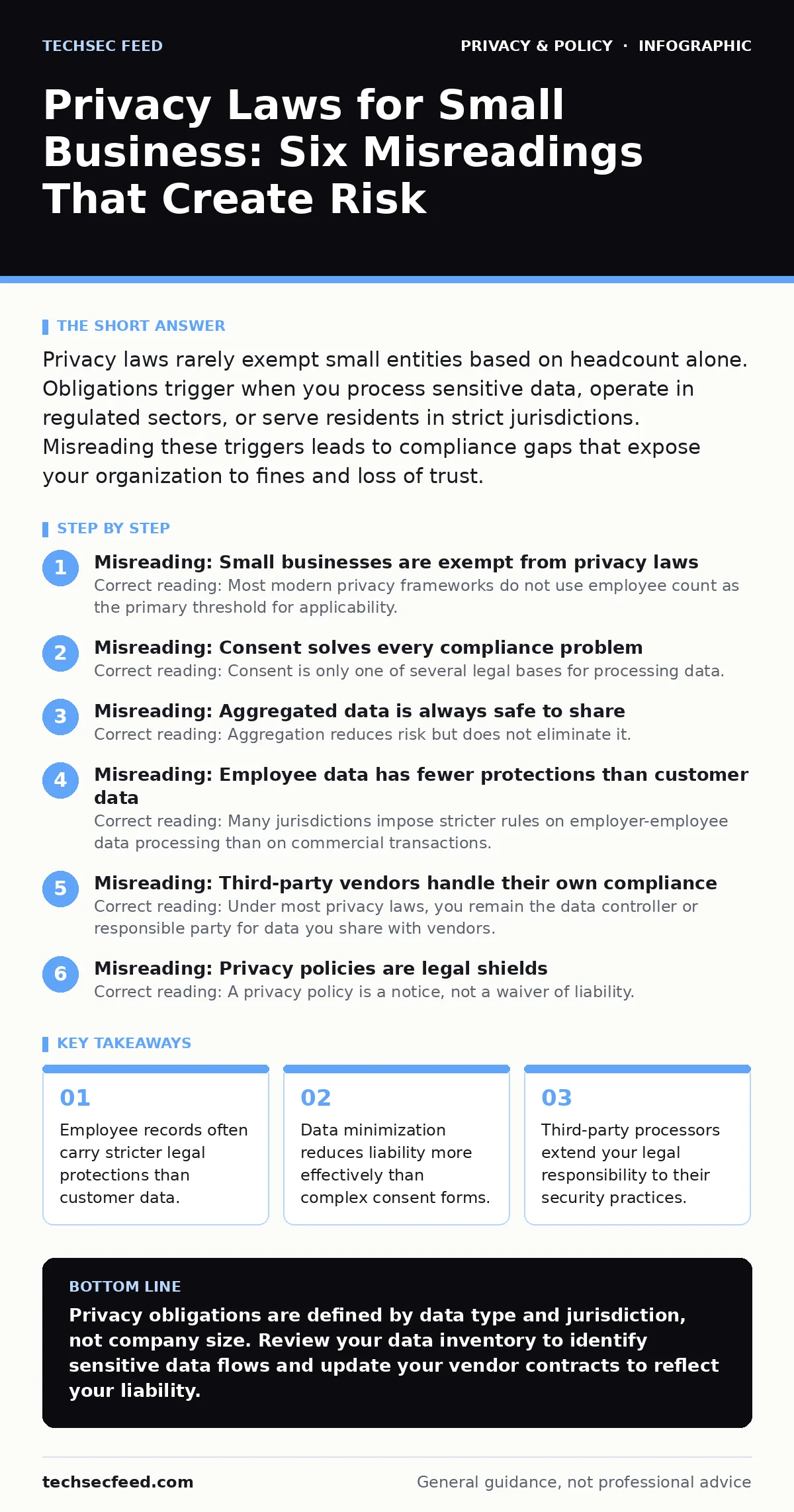
Misreading: Consent solves every compliance problem
Correct reading: Consent is only one of several legal bases for processing data. Relying on consent creates a fragile compliance posture because individuals can withdraw it at any time. If you process data for contract performance, legal obligation, or legitimate interest, consent is neither required nor appropriate. Forcing users to click "agree" to terms they do not read does not satisfy the requirement for informed, specific, and unambiguous consent. It also fails to address situations where consent is invalid, such as when there is a clear imbalance of power between the processor and the individual.
Misreading: Aggregated data is always safe to share
Correct reading: Aggregation reduces risk but does not eliminate it. If a dataset is small or unique, statistical techniques can re-identify individuals by cross-referencing the aggregated data with other public records. This process is called re-identification. Simply removing names from a customer list does not make it anonymous if the remaining fields, such as zip code, age, and purchase history, can pinpoint a single person. See our guide on anonymization for techniques that go beyond simple masking.
Misreading: Employee data has fewer protections than customer data
Correct reading: Many jurisdictions impose stricter rules on employer-employee data processing than on commercial transactions. Workplace monitoring, for instance, often requires explicit notification and, in some cases, union consultation or individual consent. Tracking keystrokes or monitoring email content without a clear policy and legitimate business reason can violate labor laws and privacy statutes. The power dynamic in employment relationships means that implied consent is rarely valid. Reviewing your workplace monitoring policies is often more urgent than updating your website cookie banner.
Misreading: Third-party vendors handle their own compliance
Correct reading: Under most privacy laws, you remain the data controller or responsible party for data you share with vendors. If a cloud provider, marketing tool, or payroll service suffers a breach, regulators look to you first. You are responsible for due diligence, which includes verifying the vendor’s security controls and ensuring their contract limits data use. Assuming a vendor is compliant because they are large or well-known is a common failure point. You must maintain a record of processing activities that documents why you share data and with whom.
See also: Small Business AI Governance: Practical Controls for Limited Teams · Right to be Forgotten Meaning: How Erasure Works in Practice
Misreading: Privacy policies are legal shields
Correct reading: A privacy policy is a notice, not a waiver of liability. It tells individuals what you do, but it does not grant you permission to do things that violate the law. If your policy states you share data with advertisers, but you actually sell that data to data brokers, the policy does not protect you. In fact, it creates evidence of deceptive practices. The policy must accurately reflect your actual technical and operational procedures. Regularly auditing your data flows ensures your documentation matches reality.
Misreading: Deleting data is just hitting the delete key
Correct reading: Digital deletion is rarely permanent. Standard deletion often marks storage space as available without overwriting the bits, allowing recovery with common software. Backups, logs, and temporary files may retain copies long after the primary record is removed. Privacy laws often require "erasure," which means making the data unrecoverable. You must establish a retention schedule that defines how long to keep data and how to securely destroy it. This includes purging backups and cached versions. See our guide on data subject access requests for the procedural requirements when an individual asks for deletion.
Misreading: Privacy is only an IT problem
Correct reading: Privacy is a business governance issue that involves legal, HR, marketing, and operations. IT can implement encryption and access controls, but they cannot define the lawful basis for processing. Legal teams must interpret jurisdiction-specific requirements. Marketing must ensure data collection methods align with privacy-by-design principles. HR must manage employee data with appropriate safeguards. Siloing privacy within the IT department leads to blind spots where non-technical processes, such as paper records or verbal data sharing, create risk. A privacy audit helps identify these gaps across the organization.
Key takeaways
- Employee records often carry stricter legal protections than customer data.
- Data minimization reduces liability more effectively than complex consent forms.
- Third-party processors extend your legal responsibility to their security practices.
Privacy obligations are defined by data type and jurisdiction, not company size. Review your data inventory to identify sensitive data flows and update your vendor contracts to reflect your liability.
Frequently asked questions
Does my business need a Data Protection Officer?
Most small businesses do not require a dedicated DPO unless they process large-scale sensitive data or conduct systematic monitoring. You can designate an existing employee or external consultant to handle these duties.
How long should I keep customer records?
Keep data only as long as necessary to fulfill the purpose for which it was collected. Once the legal or business need expires, securely delete the records. Check local tax and commercial laws for minimum retention periods.
Can I use data for new purposes later?
Generally, no. You must inform individuals of the purpose at collection. Using data for incompatible purposes requires a new legal basis or fresh consent. Check your jurisdiction’s rules on purpose limitation.
What if a vendor goes out of business?
Your contract should specify data return or destruction procedures upon termination. Ensure you have a copy of the data or a certificate of destruction before the vendor ceases operations.
How this guide was produced: written by the TechSec Feed editorial team with AI assistance, checked against the public references listed below, and reviewed when the facts change. See our editorial policy or report an error.