
Anonymization vs Pseudonymization: Which Data Strategy Fits Your Risk
Pseudonymization keeps data recoverable for business use, while true anonymization destroys the link to identity, creating distinct compliance and utility trade-offs.
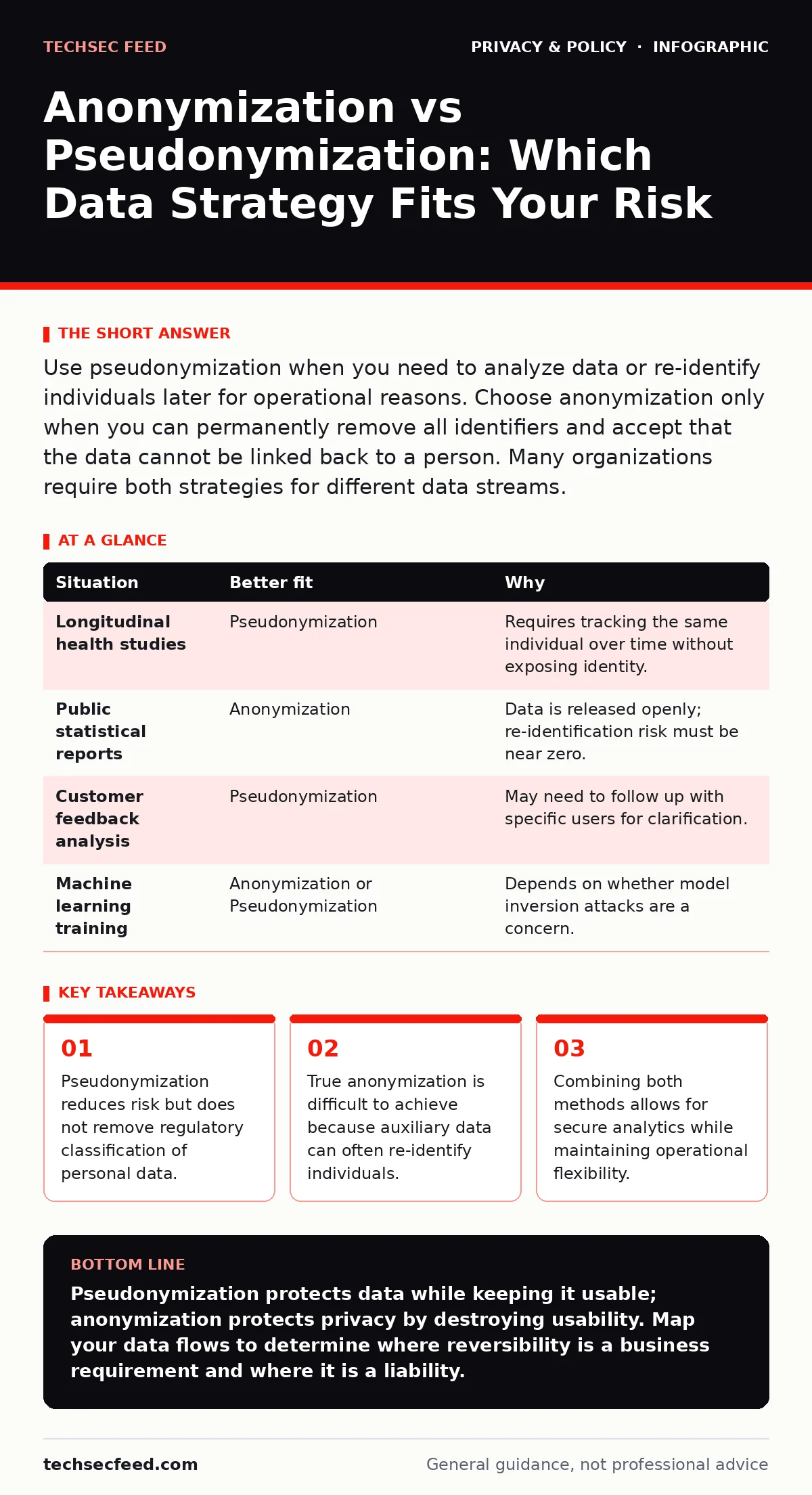
Use pseudonymization when you need to analyze data or re-identify individuals later for operational reasons. Choose anonymization only when you can permanently remove all identifiers and accept that the data cannot be linked back to a person. Many organizations require both strategies for different data streams.
Can You Re-Identify the Individual?
The primary distinction lies in reversibility. Pseudonymization replaces direct identifiers with artificial identifiers, such as codes or tokens. You retain the key to map the code back to the person. This process preserves data utility for analytics, customer service, or longitudinal studies. Because the identity can be restored, the data remains personal under most legal frameworks.
Anonymization removes or alters data so that an individual cannot be identified, even with additional information. There is no key. The link is broken permanently. If you can restore the identity, you have not anonymized the data; you have pseudonymized it. Many teams mistake hashing for anonymization. Simple hashing is reversible with dictionary attacks or rainbow tables, making it pseudonymization.
What Is the Threat Model?
You must define who might try to re-identify the data. Pseudonymization protects against casual exposure or internal misuse. If a database leaks, the attacker sees codes, not names. However, if the attacker also obtains the mapping key, the protection fails. This is a single point of failure. You must secure the key with the same rigor as the data itself.
Anonymization protects against linkage attacks. An attacker might combine your dataset with public records, such as voter rolls or social media profiles, to re-identify individuals. If your anonymization technique is weak, this combination reveals identities. True anonymization requires statistical techniques, such as k-anonymity or differential privacy, to ensure that records are indistinguishable from others. These methods add noise or generalize data, which can reduce precision.
Do You Need Data Utility?
Business operations often require linking data across systems. Pseudonymization allows you to join datasets while hiding identities from analysts. For example, a healthcare provider can track patient outcomes over time without exposing names to researchers. The utility remains high because the individual record stays intact.
Anonymization often degrades utility. To prevent re-identification, you may need to generalize ages into ranges or remove rare attributes. This loss of granularity can make the data useless for specific use cases, such as targeted marketing or precise medical research. You trade accuracy for privacy. If your business model relies on detailed individual behavior, anonymization may break your product.
| Situation | Better fit | Why |
|---|---|---|
| Longitudinal health studies | Pseudonymization | Requires tracking the same individual over time without exposing identity. |
| Public statistical reports | Anonymization | Data is released openly; re-identification risk must be near zero. |
| Customer feedback analysis | Pseudonymization | May need to follow up with specific users for clarification. |
| Machine learning training | Anonymization or Pseudonymization | Depends on whether model inversion attacks are a concern. |
When to Use Both Strategies
You are not limited to one approach. Many secure architectures use pseudonymization for internal processing and anonymization for external sharing. This layered defense separates operational needs from public risk. You keep the ability to re-identify data for critical operations, such as fraud investigation, while releasing only anonymized aggregates to partners or the public.
This separation requires strict access controls. The team that holds the re-identification key must be isolated from the team that handles the anonymized data. If the same person can access both, the anonymization is illusory. You must design your data pipelines to enforce this separation. Refer to privacy audits to verify that your access controls hold up under review.
Hidden Costs and Edge Cases
Pseudonymization introduces complexity in data management. You must manage keys, rotate tokens, and ensure that downstream systems handle the codes correctly. If a token is lost, the data becomes orphaned. This operational overhead is often underestimated. Furthermore, if you share pseudonymized data with third parties, you must ensure they cannot reverse the pseudonymization through their own data.
Anonymization has a hidden cost in data quality. Over-generalization can lead to biased models or inaccurate insights. For instance, removing rare but significant attributes may skew results toward the majority. You must validate that the anonymized dataset still represents the population accurately. Check file metadata, as it often contains hidden identifiers that survive standard anonymization processes.
See also: Data Subject Access Requests: Mechanism, Limits and Hidden Costs
Regulatory Compliance Nuances
Regulations often treat pseudonymized data as personal data. This means you must still obtain consent, provide access rights, and report breaches. Pseudonymization reduces the impact of a breach but does not remove the obligation to report it. Anonymized data, if truly anonymous, falls outside these obligations. However, regulators scrutinize anonymization claims heavily. They will look for any residual risk of re-identification.
Understanding privacy laws for small businesses can help clarify these obligations. The definitions vary by jurisdiction, but the core principle remains: if it is personal data, you must protect it. Pseudonymization is a security measure, not a compliance exemption. Anonymization is a classification change. Choose based on whether you need the exemption or the security benefit.
Key takeaways
- Pseudonymization reduces risk but does not remove regulatory classification of personal data.
- True anonymization is difficult to achieve because auxiliary data can often re-identify individuals.
- Combining both methods allows for secure analytics while maintaining operational flexibility.
Pseudonymization protects data while keeping it usable; anonymization protects privacy by destroying usability. Map your data flows to determine where reversibility is a business requirement and where it is a liability.
Frequently asked questions
Is hashing a form of anonymization?
No, standard hashing is pseudonymization because it can often be reversed with sufficient computational power or dictionary attacks. Only irreversible, salted, or tokenized methods approach anonymization, but even then, linkage attacks remain a risk.
Can I pseudonymize data and then share it publicly?
You should not share pseudonymized data publicly unless you are certain no external data can link the pseudonym to an identity. Public exposure increases the attack surface for re-identification, making true anonymization safer for public releases.
Does pseudonymization reduce the impact of a data breach?
Yes, it limits the immediate harm by hiding direct identifiers. However, if the mapping key is also compromised, the breach impact is identical to a full data leak. It mitigates, but does not eliminate, risk.
How do I know if my data is truly anonymous?
You cannot be certain without rigorous statistical testing and threat modeling. You must consider all available external datasets and attack vectors. If any reasonable person could re-identify an individual, the data is not anonymous.
How this guide was produced: written by the TechSec Feed editorial team with AI assistance, checked against the public references listed below, and reviewed when the facts change. See our editorial policy or report an error.