
Hardcoded Secrets Prevention Checklist for Secure Source Code
Static analysis tools often miss secrets embedded in configuration files or build scripts, requiring layered detection methods.
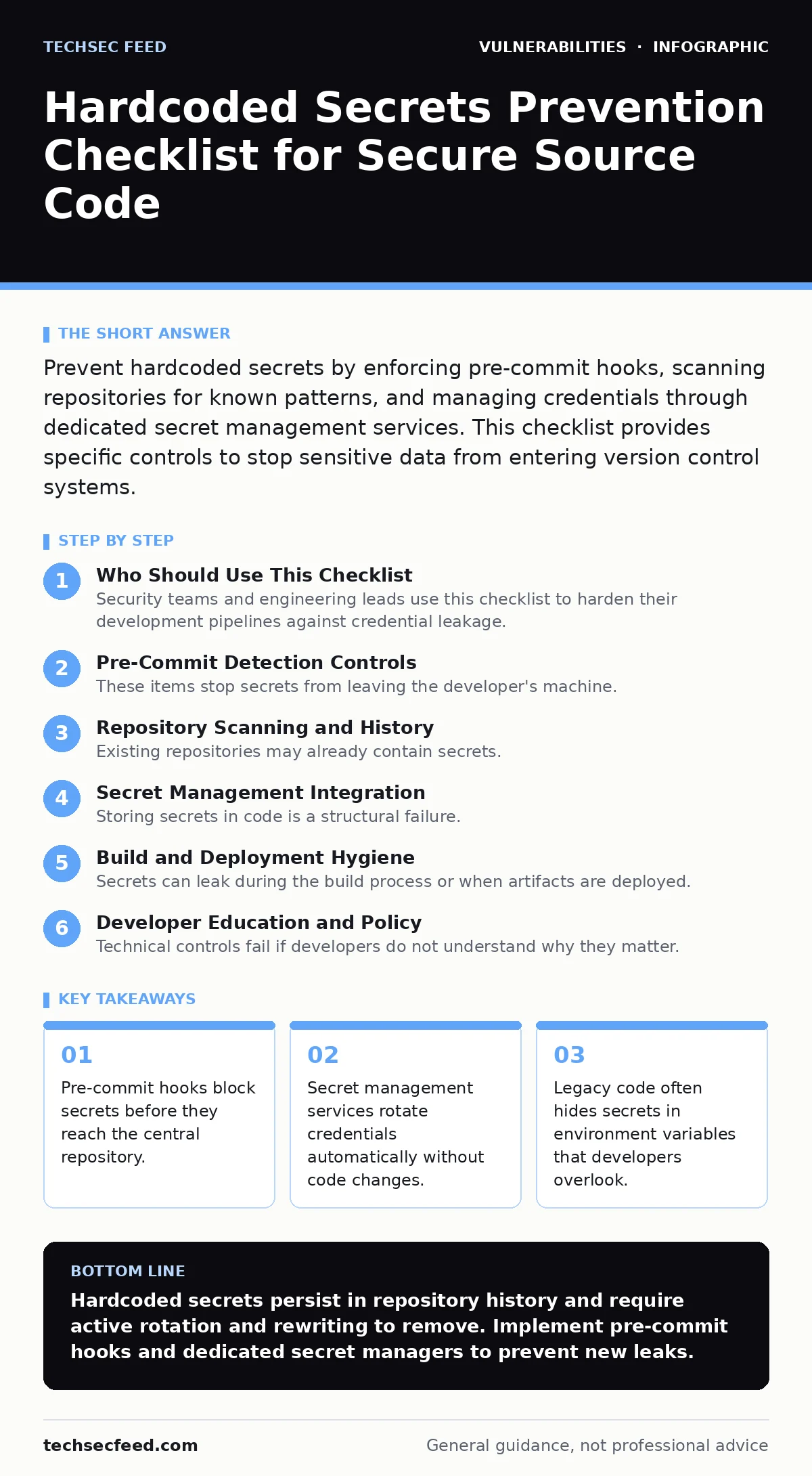
Prevent hardcoded secrets by enforcing pre-commit hooks, scanning repositories for known patterns, and managing credentials through dedicated secret management services. This checklist provides specific controls to stop sensitive data from entering version control systems.
Who Should Use This Checklist
Security teams and engineering leads use this checklist to harden their development pipelines against credential leakage. You apply these controls to catch sensitive data before it enters version control. The list covers detection, prevention, and remediation steps. Use it to audit your current workflow and identify gaps in your secret management strategy.
Pre-Commit Detection Controls
These items stop secrets from leaving the developer's machine. They rely on local tools that scan code before it is committed.
- Install pre-commit hooks: Hooks run scans locally and block commits containing detected secrets.
- Configure pattern matching rules: Custom regex patterns catch organization-specific secret formats that generic tools miss.
- Enforce hook execution: Mandatory hooks prevent developers from bypassing checks with command-line flags.
- Include documentation in hooks: Clear error messages tell developers exactly which file and line contain the secret.
- Test hooks in CI: Continuous integration pipelines verify that hooks are active and up-to-date on all branches.
Repository Scanning and History
Existing repositories may already contain secrets. You must find and remove them from history, not just the current branch.
- Scan full repository history: Tools that scan commit history find secrets that were deleted but remain in older commits.
- Purge sensitive data from history: Rewriting history removes secrets from all branches, not just the current one.
- Rotate exposed credentials immediately: Any secret found in history must be considered compromised and replaced.
- Audit for shadow repositories: Private forks or personal repositories often contain unmonitored copies of sensitive code.
- Check for encoded secrets: Base64 or hex-encoded strings often bypass simple text searches for keywords.
Secret Management Integration
Storing secrets in code is a structural failure. You must move credentials to systems designed for secure storage and rotation.
- Use a dedicated secret manager: Services like HashiCorp Vault or AWS Secrets Manager handle storage and access control.
- Implement dynamic credentials: Generate short-lived tokens for services instead of using long-lived static passwords.
- Restrict access to secret stores: Apply least-privilege principles so only necessary services can read specific secrets.
- Automate secret rotation: Scheduled rotation reduces the window of exposure if a secret is leaked.
- Avoid environment variables for secrets: Environment variables are often logged or visible to other processes on the host.
Build and Deployment Hygiene
Secrets can leak during the build process or when artifacts are deployed. You must secure the pipeline itself.
- Scan build artifacts: Check Docker images and compiled binaries for embedded credentials before deployment.
- Isolate build environments: Use ephemeral build agents that are destroyed after each run to prevent credential persistence.
- Encrypt pipeline variables: Store pipeline secrets in encrypted variables, not in plain-text configuration files.
- Audit deployment logs: Ensure logs do not print sensitive values when applications start or fail.
- Verify container image layers: Secrets baked into image layers persist even if deleted in later layers.
See also: GraphQL Vulnerabilities: 9 Critical Questions Answered · Asset Inventory Mistakes That Break Patching Workflows
Developer Education and Policy
Technical controls fail if developers do not understand why they matter. Training must be specific and actionable.
- Define acceptable secret types: Clearly list what constitutes a secret, including API keys and certificates.
- Provide safe alternatives: Show developers how to use secret managers in their preferred languages and frameworks.
- Conduct regular code reviews: Peer reviews catch context-specific secrets that automated tools might miss.
- Integrate security into onboarding: New hires learn secret management practices from day one of their employment.
- Reward secure behavior: Recognize teams that successfully implement and maintain secret hygiene standards.
Related Security Practices
Hardcoded secrets often interact with other vulnerabilities. Understanding these connections helps you prioritize fixes. For example, a leaked API key might enable command injection if the key grants access to a vulnerable service. Similarly, secrets found in open-source projects can lead to vulnerability chaining where an attacker combines multiple weaknesses.
You should also consider how software bill of materials (SBOM) tools can help identify third-party libraries that might contain hidden credentials. If you are dealing with critical infrastructure, check CISA KEV due dates to ensure any associated vulnerabilities are patched promptly.
Key takeaways
- Pre-commit hooks block secrets before they reach the central repository.
- Secret management services rotate credentials automatically without code changes.
- Legacy code often hides secrets in environment variables that developers overlook.
Hardcoded secrets persist in repository history and require active rotation and rewriting to remove. Implement pre-commit hooks and dedicated secret managers to prevent new leaks.
Frequently asked questions
How do I remove a secret from Git history?
Use tools like git-filter-repo to rewrite history and remove the secret from all commits. Then force-push the changes and rotate the credential immediately.
Can environment variables be considered secure?
Environment variables are not secure for long-term storage. They are visible to other processes and often logged, making them a poor choice for sensitive data.
What is the difference between a secret and a configuration value?
Configuration values are non-sensitive settings like feature flags. Secrets are credentials that grant access to systems or data and must be protected.
How often should I rotate secrets?
Rotate secrets regularly, ideally automatically. Short-lived credentials reduce the risk of compromise and limit the damage if a secret is leaked.
How this guide was produced: written by the TechSec Feed editorial team with AI assistance, checked against the public references listed below, and reviewed when the facts change. See our editorial policy or report an error.