
Why do tls certificates expire and how to manage the lifecycle
Cryptographic keys decay in trust value over time, forcing frequent renewals to prevent silent system failures.
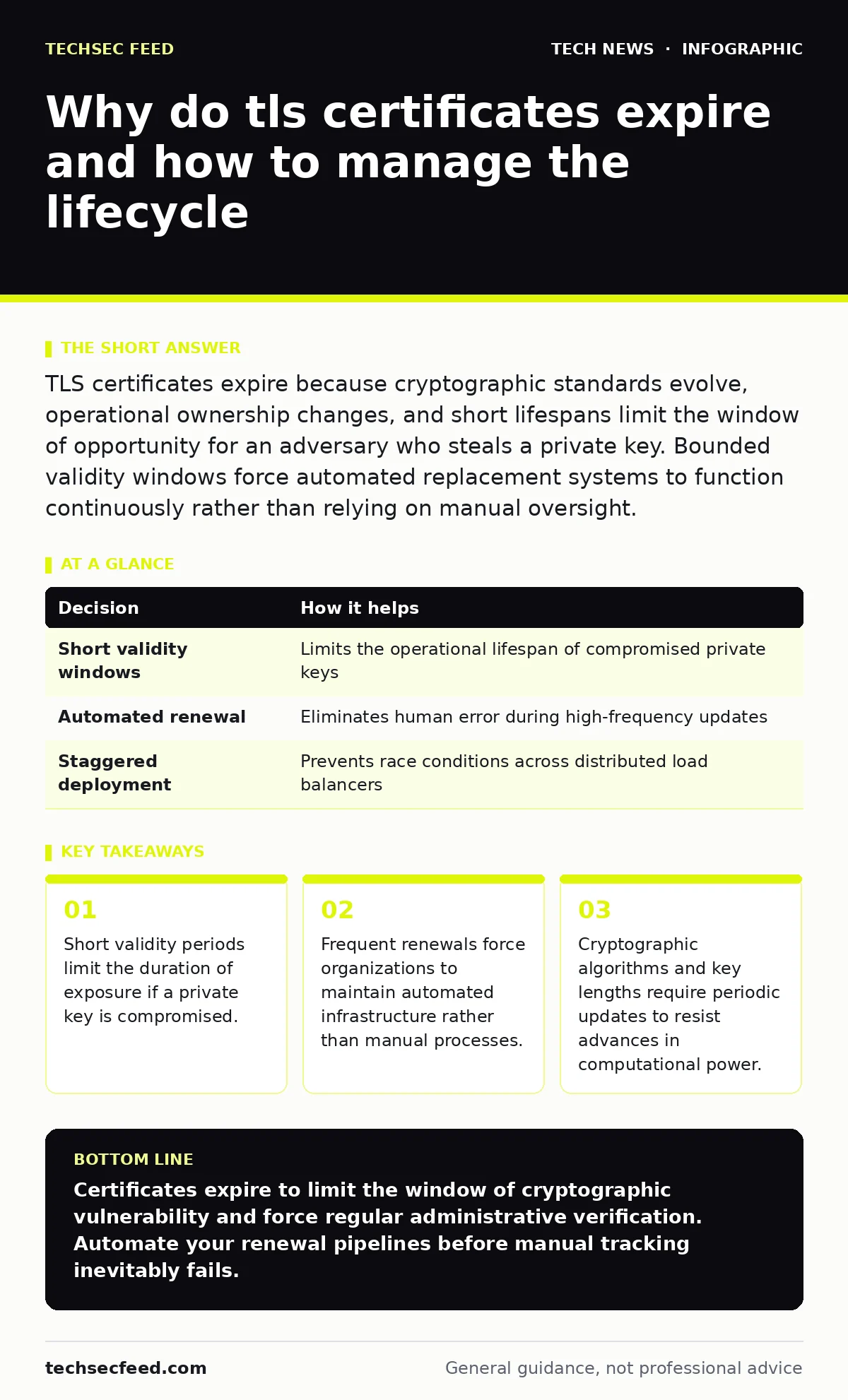
TLS certificates expire because cryptographic standards evolve, operational ownership changes, and short lifespans limit the window of opportunity for an adversary who steals a private key. Bounded validity windows force automated replacement systems to function continuously rather than relying on manual oversight.
Why do tls certificates expire by design
Transport Layer Security certificates expire because cryptographic trust requires an expiration date to limit the lifespan of any single cryptographic credential.
Cryptographic keys are strings of data used to encrypt and decrypt traffic.
Over time, the computing power available to attackers increases, making older, shorter keys vulnerable to brute-force attacks.
A finite validity period ensures that old cryptographic parameters cannot persist indefinitely within a network.
Short lifespans also mitigate the damage caused by administrative neglect or undetected theft.
Imagine a web server whose private key is quietly copied by an unauthorized observer during a network intrusion.
If that certificate remains valid for a decade, the intruder retains a long-term decryption capability for past and future sessions.
Truncating validity windows limits the utility of stolen credentials and forces frequent re-authentication of server identity.
Cryptographic evolution and key rotation
Cryptographic algorithms weaken over time as mathematicians discover new analytical weaknesses or hardware processing speeds improve.
An algorithm considered secure today might become susceptible to factorization or collision attacks within a few years.
Enforcing expiration forces system administrators to transition to stronger cryptographic primitives during routine renewals.
This mechanism prevents legacy systems from operating indefinitely on obsolete security assumptions.
Key rotation is the practical counterpart to algorithm evolution.
Replacing a certificate requires generating a new key pair, which updates the underlying math protecting the connection.
Systems that attempt to bypass this process often run afoul of browser security settings that reject outdated cryptographic parameters.
Regular expiration cycles guarantee that systems shed weak configurations before browsers actively block them.
Operational hygiene and ownership verification
Certificates bind a domain name to a specific organizational entity and public key.
Organizations expand, contract, and transfer domains frequently, meaning the original owner of a certificate may no longer control the infrastructure.
Expiration acts as a mandatory verification checkpoint that confirms the entity still controls the domain in question.
Without this check, abandoned domains could point to valid, trusted certificates held by former administrative staff or third-party vendors.
Maintaining valid credentials requires rigorous internal tracking that intersects with secure software development practices.
When teams automate the renewal process, they reduce the risk of human error causing sudden outages.
Conversely, manual tracking frequently fails when system administrators change roles or depart.
For deeper organizational oversight, teams often integrate certificate management workflows directly into their infrastructure deployment pipelines.
The mechanics of validation failure
When a certificate passes its expiration timestamp, client applications immediately terminate the connection and display a blocking warning.
Browsers and operating systems check validity dates during the initial connection handshake before any application data moves.
This strict enforcement prevents fallback behaviors that attackers might otherwise exploit to inject malicious content.
The failure is binary: a expired credential offers no encryption at all to the end user.
Automated monitoring tools help catch impending expirations, but they fail if the underlying notification pathways break.
Network administrators sometimes pair these checks with network access control policies to isolate servers that fail cryptographic validation.
However, automated renewal clients can fail silently due to rate limits imposed by public certificate authorities or blocked validation ports.
Relying solely on automation without monitoring the renewal logs creates a false sense of security.
Hidden costs of premature and delayed renewals
Renewing certificates too frequently introduces operational overhead and potential race conditions in distributed systems.
If multiple load balancers pull a new certificate at slightly different times, clients may experience intermittent validation errors during the transition window.
Conversely, delayed renewals cause immediate service degradation that can trigger cascading failures in dependent microservices.
These outages often cost more in lost revenue and debugging time than the infrastructure required to automate the lifecycle.
| Decision | How it helps |
|---|---|
| Short validity windows | Limits the operational lifespan of compromised private keys |
| Automated renewal | Eliminates human error during high-frequency updates |
| Staggered deployment | Prevents race conditions across distributed load balancers |
See also: Generative AI Defined: Mechanics, Origins, and Operational Reality
Alternatives and mitigations for lifecycle management
Organizations attempting to bypass the operational burden of frequent renewals sometimes explore alternative trust models or extended validation periods.
However, public certificate authorities and browser vendors reject long-lived credentials because the risk of key compromise outweighs the convenience.
Mitigations instead focus on robust monitoring, fallback routing, and strict separation of duties between certificate issuance and application deployment.
When automation fails, engineers must be able to fall back on documented emergency issuance procedures.
Integrating these practices requires aligning security operations with network address translation configurations and load balancing architectures.
If a reverse proxy terminates TLS before forwarding traffic to backend servers, the expiration monitoring must target the proxy layer rather than the internal nodes.
Understanding where termination occurs prevents blind spots where expired internal credentials go unnoticed until a catastrophic failure halts production traffic.
Key takeaways
- Short validity periods limit the duration of exposure if a private key is compromised.
- Frequent renewals force organizations to maintain automated infrastructure rather than manual processes.
- Cryptographic algorithms and key lengths require periodic updates to resist advances in computational power.
Certificates expire to limit the window of cryptographic vulnerability and force regular administrative verification. Automate your renewal pipelines before manual tracking inevitably fails.
Frequently asked questions
What happens immediately when a tls certificate expires?
Client applications immediately reject the connection and display a prominent security warning, halting all encrypted communication.
Can an expired certificate still encrypt network traffic?
The underlying mathematical encryption may still function, but client software refuses to establish a session because trust validation fails.
How do automated tools prevent expiration outages?
Automated agents communicate with certificate authorities to request, validate, and deploy new credentials before the existing ones reach their deadline.
Why do modern browsers shorten maximum certificate lifespans?
Shorter lifespans reduce the duration that compromised keys remain useful to attackers and accelerate the adoption of stronger cryptographic standards.
How this guide was produced: written by the TechSec Feed editorial team with AI assistance, checked against the public references listed below, and reviewed when the facts change. See our editorial policy or report an error.