
Legitimate Interest under GDPR: How Small Teams Process Data Safely
Choosing legitimate interest over consent shifts the legal burden onto your organization while removing the user's absolute right to revoke permission.
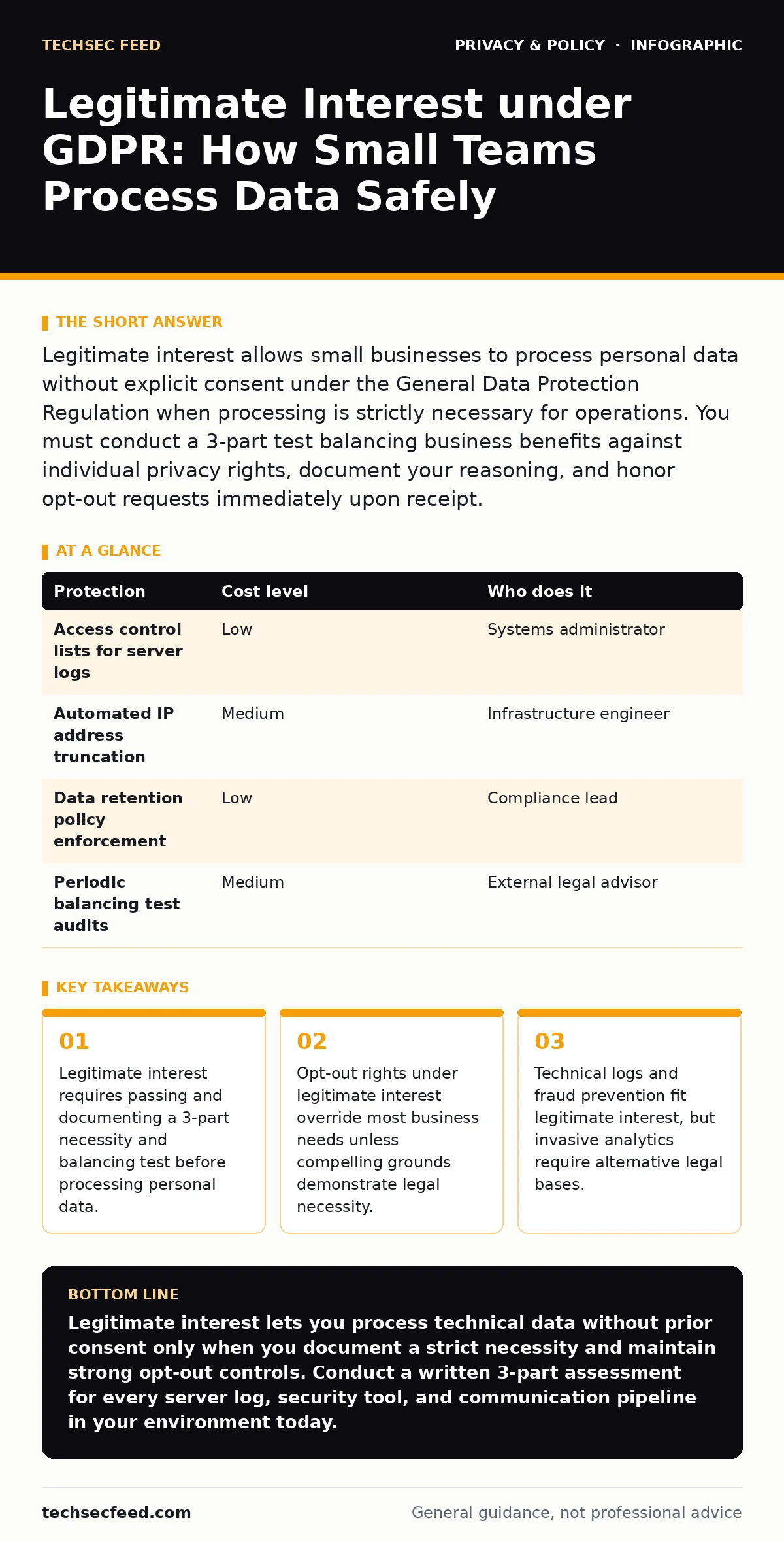
Legitimate interest allows small businesses to process personal data without explicit consent under the General Data Protection Regulation when processing is strictly necessary for operations. You must conduct a 3-part test balancing business benefits against individual privacy rights, document your reasoning, and honor opt-out requests immediately upon receipt.
Balancing Business Goals Against Personal Privacy Rights
Legitimate interest serves as one of 6 lawful bases under the General Data Protection Regulation, the legal framework governing personal data processing across European jurisdictions. Small operations choose this basis when securing network perimeters, detecting software fraud, or routing administrative communications. Choosing this basis avoids consent fatigue, but forces you to prove that operational needs outweigh individual privacy rights.
Small businesses frequently mistake legitimate interest for an open-ended permission slip to gather employee and customer information. Broad privacy laws for small businesses mandate that every data pipeline serves a specific purpose without creating unfair outcomes for data subjects, the individuals whose personal information you store. If an individual unexpectedly suffers harm or loss of control, regulators will reject your justification.
Conducting the 3-Part Legitimate Interest Assessment
You must execute a 3-part assessment before collecting personal data under this justification. First, define the purpose test by identifying the specific commercial or security objective. Second, evaluate the necessity test by demonstrating that no less intrusive mechanism exists to achieve that outcome. Third, run the balancing test by weighing your operational gains against the expectation of privacy.
The balancing test requires you to consider context, data sensitivity, and vulnerable populations. Processing basic telemetry from application logs carries low risk, whereas capturing file metadata, which contains hidden author signatures and embedded system timestamps, creates elevated privacy exposure. You must record these findings in writing before initiating data collection.
Operationalizing Legitimate Interest Across Daily Workflows
Deploying this legal ground requires clear documentation within your public privacy notice. You must explain the precise interest pursued, provide an easy opt-out mechanism, and process incoming data subject access requests, which are formal demands from individuals seeking copies of their personal data. Failing to explain your reasoning in clear language invalidates your legal defense.
Internal operations require equal scrutiny when monitoring corporate infrastructure. Using telemetry to audit employee laptop connections falls under legitimate interest, but excessive surveillance triggers friction. Reviewing our guide on workplace monitoring reveals how continuous keylogging or video recording breaches proportionality bounds, exposing your business to administrative penalties.
Technical and Organizational Safeguards for Small Teams
Technical controls minimize data exposure and lower privacy risks during security processing. Restricting log access to authorized engineers, truncating IP addresses after 14 days, and setting automated retention periods satisfy legal requirements. These practical measures demonstrate that your organization actively limits harm while fulfilling legitimate commercial obligations.
| Protection | Cost level | Who does it |
|---|---|---|
| Access control lists for server logs | Low | Systems administrator |
| Automated IP address truncation | Medium | Infrastructure engineer |
| Data retention policy enforcement | Low | Compliance lead |
| Periodic balancing test audits | Medium | External legal advisor |
What Should You Ask an IT Provider About Legitimate Interest?
When evaluating an IT provider about legitimate interest under privacy regulations, you must ask about data collection bases, log retention periods, and opt-out mechanisms. You must pose these 6 questions to verify compliance:
- Does your platform process personal data under legitimate interest or relying on explicit user consent?
- Where can our team inspect documented necessity assessments for default telemetry collection?
- What precise mechanism purges user records when a customer exercises their right to object?
- How long do backup systems retain raw security logs before applying network anonymization?
- Which specific third-party subprocessors access our system logs during routine maintenance?
- How do your administrative tools isolate operational metrics from customer message content?
See also: Privacy Laws for Small Business: Six Misreadings That Create Risk · Small Business AI Governance: Practical Controls for Limited Teams
Managing Edge Cases and Systemic Privacy Risks
Edge cases arise when business requirements collide with unexpected privacy rights. For example, retaining financial transaction records for fraud prevention meets legitimate interest standards, but using that same data to build advertising profiles violates European rules. Converting operational data into secondary sales pipelines requires fresh legal justifications or direct consent.
Security incident response highlights another non-obvious trade-off. Maintaining long-term network packet captures helps investigate past security breaches, yet storing unencrypted network traffic retains sensitive user credentials and private messages. Truncating sensitive payloads while keeping network header metadata strikes the correct balance between forensic defense and compliance.
Key takeaways
- Legitimate interest requires passing and documenting a 3-part necessity and balancing test before processing personal data.
- Opt-out rights under legitimate interest override most business needs unless compelling grounds demonstrate legal necessity.
- Technical logs and fraud prevention fit legitimate interest, but invasive analytics require alternative legal bases.
Legitimate interest lets you process technical data without prior consent only when you document a strict necessity and maintain strong opt-out controls. Conduct a written 3-part assessment for every server log, security tool, and communication pipeline in your environment today.
Frequently asked questions
Can small businesses use legitimate interest for cold email outreach?
Cold email outreach to individual consumers generally requires explicit prior consent under European privacy rules. Business-to-business communications may rely on legitimate interest if the offer directly relates to the recipient's professional role and an easy opt-out mechanism is included.
How does legitimate interest differ from explicit user consent?
Explicit user consent requires individuals to take an active step before you process personal data. Legitimate interest allows processing without prior permission, but requires you to justify the business necessity and respect immediate user objections.
What happens when a user objects to processing under legitimate interest?
When a user objects to processing under legitimate interest, you must immediately stop processing their personal data unless you can demonstrate compelling legitimate grounds. For direct marketing, the right to object is absolute, meaning you must cease processing without exception.
Do small businesses need written records for legitimate interest claims?
Small businesses must maintain written records of their legitimate interest assessments to demonstrate compliance to regulatory authorities. Documenting the purpose, necessity, and balancing test before processing data provides essential proof if a privacy dispute or audit occurs.
How this guide was produced: written by the TechSec Feed editorial team with AI assistance, checked against the public references listed below, and reviewed when the facts change. See our editorial policy or report an error.