
Understanding embeddings and how machines measure meaning
Mathematical vectors convert human language into coordinates so software can compute semantic similarity.
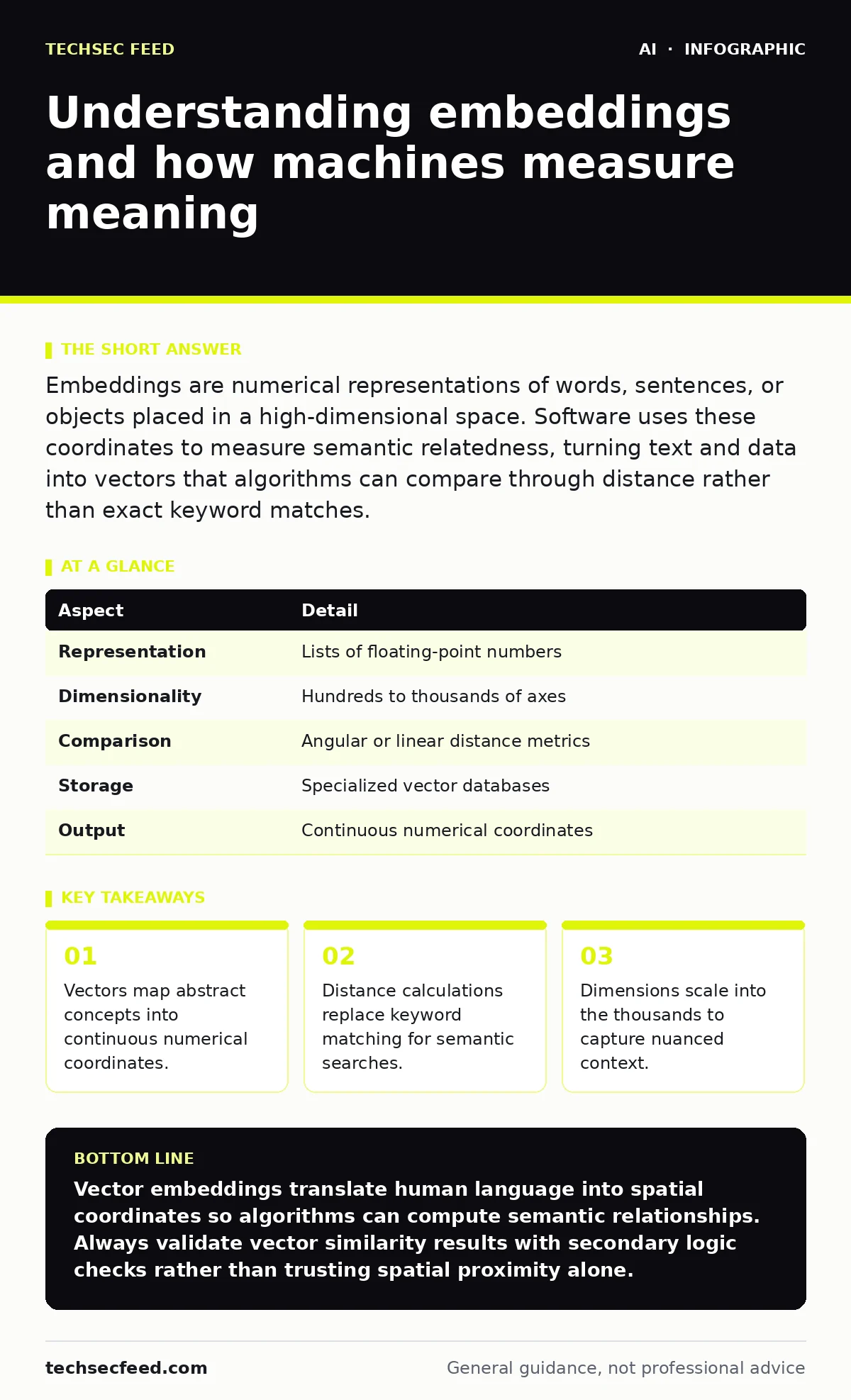
Embeddings are numerical representations of words, sentences, or objects placed in a high-dimensional space. Software uses these coordinates to measure semantic relatedness, turning text and data into vectors that algorithms can compare through distance rather than exact keyword matches.
Mapping Meaning Into Coordinates
Imagine a massive library where every book sits on a shelf determined entirely by its plot, tone, and subject matter rather than its title or author. Embeddings achieve this spatial arrangement for digital data by converting words, phrases, or entire documents into lists of numbers called vectors. Mathematical operations can then measure the distance between these coordinates to determine how closely related two pieces of text are in meaning.
Vector spaces place synonyms close together while pushing unrelated terms far apart. A single vector might contain thousands of individual coordinates, each representing a subtle axis of meaning like formality, tense, or domain specificity. Computers process these numbers efficiently, allowing software to understand context and nuance without comprehending human language in a biological sense.
Translating Language Into Numbers
Linguistic translation into vectors happens through neural networks trained on vast corpuses of text. These models analyze which words frequently appear in similar contexts, gradually assigning numerical positions to every token in a vocabulary. Words sharing overlapping usage patterns acquire similar coordinates within the high-dimensional space.
Mathematical distance metrics calculate the similarity between two resulting vectors. Cosine similarity measures the angle between two vectors originating from the same point, ignoring magnitude to focus purely on directional alignment. Euclidean distance measures the absolute length of the straight line segment between two coordinate points in the multi-dimensional space.
The Anatomy of Vector Spaces
| Aspect | Detail |
|---|---|
| Representation | Lists of floating-point numbers |
| Dimensionality | Hundreds to thousands of axes |
| Comparison | Angular or linear distance metrics |
| Storage | Specialized vector databases |
| Output | Continuous numerical coordinates |
Vector spaces do not possess fixed physical directions for specific concepts like gender or geography. Instead, the axes emerge organically during training to minimize prediction error across the entire corpus. This dynamic formation means the same word can receive slightly different coordinates depending on the model architecture and training data leakage risks inherent in the source material.
Practical Applications in Security Operations
Vector embeddings power modern search engines, recommendation systems, and semantic analysis tools by bypassing rigid keyword constraints. Security teams rely on these models to flag phishing emails that use completely novel phrasing but share the underlying malicious intent of known attacks. When organizations implement training data leakage protections, vector analysis helps identify unauthorized document duplication across internal repositories.
Semantic search engines convert user queries into vectors and retrieve documents with the closest spatial coordinates, finding relevant policies even when the search terms never appear in the target text. Software pipelines also apply this technique to detect anomalous code structures or spot unusual user behavior patterns. These operations convert unstructured text logs into manageable coordinates that trigger alerts when a session drifts too far from baseline norms.
Hidden Costs of Spatial Geometry
Dimensionality reduction creates a trade-off between computational efficiency and semantic fidelity. Compressing thousands of dimensions down to a smaller set speeds up similarity searches but strips away the subtle contextual nuances that separate benign requests from sophisticated attacks.
Vector spaces also suffer from hallucination amplification when models project ambiguous inputs into crowded regions of the coordinate map. Software treating these coordinates as absolute truth may misclassify legitimate operational traffic as hostile simply because two unrelated concepts share a mathematical neighbor in the vector space. When evaluating machine learning for fraud detection, engineers must account for the reality that distance in a vector space does not always equal logical causality.
See also: Machine Learning for Fraud Detection: How It Works and What It Misses · Large Language Models vs Machine Learning: Core Differences Explained
What People Get Wrong About Vectors
Many practitioners assume embeddings possess a permanent, objective understanding of truth and factual accuracy. Vector models capture statistical co-occurrence rather than objective reality, meaning a persistently repeated falsehood will acquire coordinates that make it appear highly valid.
Another frequent error involves treating vector distance as a direct measure of human emotional intent. Two sentences can occupy nearby coordinates while carrying entirely different operational implications due to a single negated verb or a subtle shift in grammatical context.
Key takeaways
- Vectors map abstract concepts into continuous numerical coordinates.
- Distance calculations replace keyword matching for semantic searches.
- Dimensions scale into the thousands to capture nuanced context.
Vector embeddings translate human language into spatial coordinates so algorithms can compute semantic relationships. Always validate vector similarity results with secondary logic checks rather than trusting spatial proximity alone.
Frequently asked questions
How do models handle words they have never seen before?
Tokenizers break unfamiliar words down into smaller sub-word components or character sequences, allowing the model to generate a composite vector from familiar pieces.
Why do vector databases require specialized indexing methods?
Exact nearest-neighbor searches become computationally prohibitive in high-dimensional spaces, forcing systems to use approximate indexing algorithms that trade absolute precision for speed.
Can embeddings be reversed back into the original text?
Vectors represent lossy compression of the source data, meaning you cannot reliably reconstruct the exact original sentence from its coordinates alone.
Do different embedding models produce compatible vector spaces?
Models trained on different architectures or datasets generate completely incompatible coordinate spaces, meaning vectors from one model cannot be directly compared to vectors from another.
How this guide was produced: written by the TechSec Feed editorial team with AI assistance, checked against the public references listed below, and reviewed when the facts change. See our editorial policy or report an error.