
Shadow AI Response: containment and recovery steps for unauthorized tools
Discovering unmanaged artificial intelligence tools requires immediate scoping rather than knee-jerk network blocking that breaks workflows.
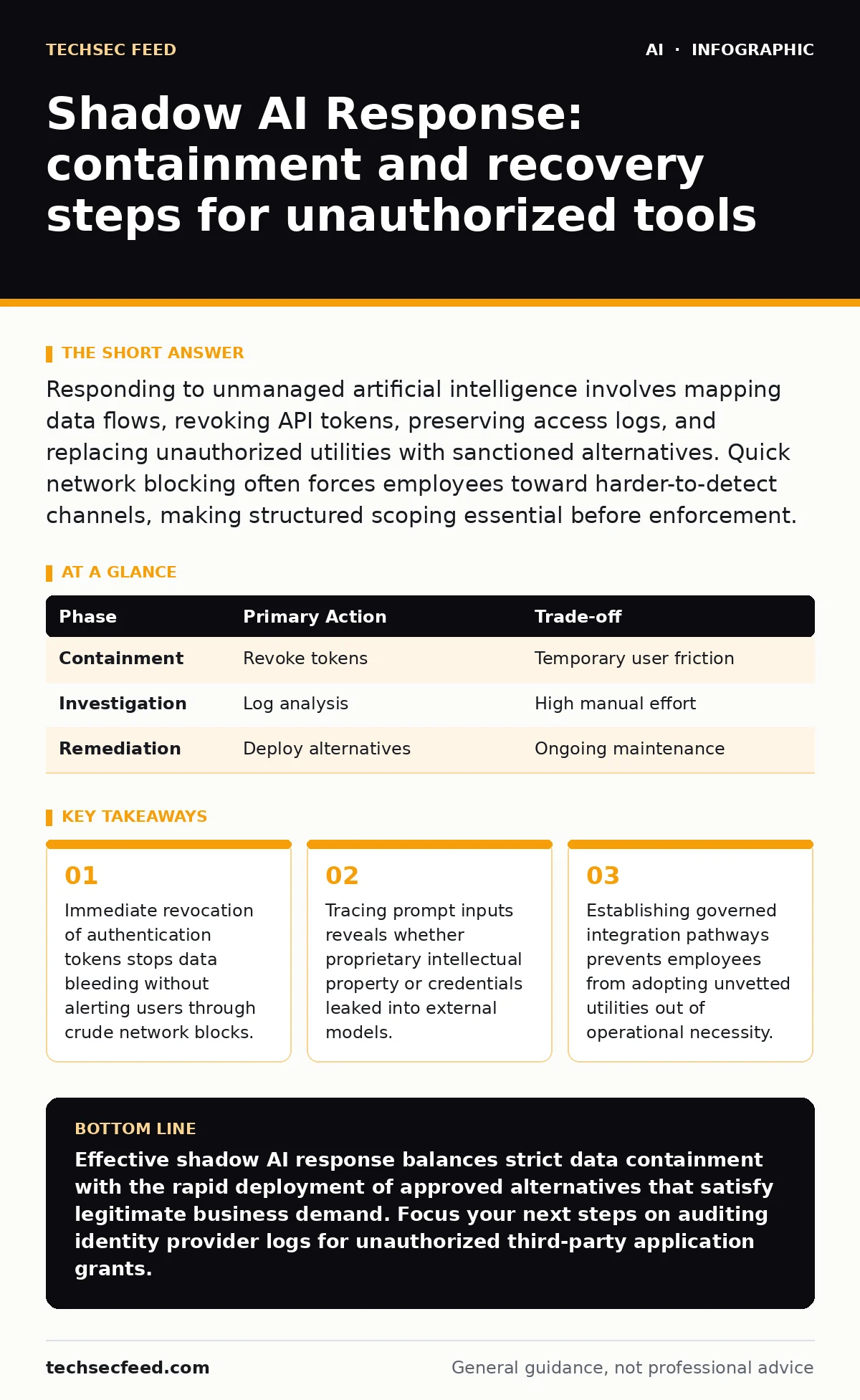
Responding to unmanaged artificial intelligence involves mapping data flows, revoking API tokens, preserving access logs, and replacing unauthorized utilities with sanctioned alternatives. Quick network blocking often forces employees toward harder-to-detect channels, making structured scoping essential before enforcement.
Understanding shadow AI exposure
Unmanaged artificial intelligence encompasses any third-party machine learning utility, API integration, or browser extension deployed by employees without explicit authorization from technology governance teams. This phenomenon bypasses traditional procurement vetting, creating blind spots where sensitive intellectual property or customer records flow directly into external systems. Unlike standard software installations, these tools often process unstructured data in ways that defy conventional perimeter monitoring.
Shadow AI creates unique risks because employees frequently paste internal source code, financial spreadsheets, and strategic documents into conversational interfaces to accelerate daily tasks. Treating AI models as untrusted insiders helps reframe your containment strategy around strict data egress limits rather than simple software removal. Identifying the boundaries of this exposure requires examining browser telemetry, proxy logs, and authentication tokens issued by third-party identity providers.
First hour
Immediate triage during the first hour dictates whether an unmanaged deployment remains an isolated anomaly or escalates into a systemic data exposure event. Panic often leads to severe operational disruption, but measured containment preserves both forensic integrity and business continuity.
First hour checklist
- Revoke all active API tokens associated with the unapproved artificial intelligence service
- Export proxy and firewall logs showing destination endpoints and data volume transferred
- Notify legal and privacy stakeholders without naming specific employee infractions prematurely
- Preserve local browser cache and memory dumps from workstations suspected of heavy usage
First day
Uncovering the full scope of unauthorized adoption demands systematic investigation into how data reached the external service and what information remains cached on remote servers. Comprehensive incident response requires collaborating with network administrators to map every outbound connection originating from internal user segments.
Data exfiltration assessment involves reviewing outbound payload sizes and frequency patterns against baseline user behavior. Many generative AI platforms retain user prompts for model training, meaning proprietary information submitted during early testing might persist indefinitely in remote vector databases. Determining whether confidential data entered these systems dictates your downstream notification obligations to affected customers and regulatory bodies.
Authentication analysis uncovers how employees gained access to these external platforms in the first place. Corporate credit cards, personal email registration, and bypassed single-sign-on protocols all represent distinct vectors that require remediation.
First week
Stabilizing the environment after an unmanaged artificial intelligence incident requires transitioning from reactive containment to permanent architectural adjustment. Employees adopt unapproved utilities when official channels fail to meet their productivity requirements, meaning prohibition alone guarantees failure.
Remediation workflows must introduce friction-free, sanctioned alternatives that satisfy the business need while maintaining strict data governance. Establishing clear access controls for AI agents ensures that internal models operate under the principle of least privilege, preventing unauthorized data aggregation across departmental boundaries.
| Phase | Primary Action | Trade-off |
|---|---|---|
| Containment | Revoke tokens | Temporary user friction |
| Investigation | Log analysis | High manual effort |
| Remediation | Deploy alternatives | Ongoing maintenance |
Policy updates must explicitly define permissible data classifications for artificial intelligence interactions rather than issuing blanket bans that encourage covert usage. Training programs should emphasize practical data hygiene, demonstrating specifically what happens when sensitive information enters external training pipelines.
See also: AI Hallucination Incident Response and Recovery Steps
Stopping future occurrences
Preventing recurrence relies on continuous discovery mechanisms that identify unvetted integrations before employees incorporate them into standard operational workflows. Network layer inspection tools must look for specific cryptographic handshakes and payload structures characteristic of external machine learning interfaces.
Behavioral anomaly detection helps spot unusual data aggregation patterns that precede unauthorized model adoption. When departments express legitimate demand for advanced computational capabilities, rapid procurement channels eliminate the motivation to seek out shadow alternatives.
Key takeaways
- Immediate revocation of authentication tokens stops data bleeding without alerting users through crude network blocks.
- Tracing prompt inputs reveals whether proprietary intellectual property or credentials leaked into external models.
- Establishing governed integration pathways prevents employees from adopting unvetted utilities out of operational necessity.
Effective shadow AI response balances strict data containment with the rapid deployment of approved alternatives that satisfy legitimate business demand. Focus your next steps on auditing identity provider logs for unauthorized third-party application grants.
Frequently asked questions
What makes shadow AI different from traditional shadow IT?
Traditional shadow IT involves unauthorized software installations or cloud storage buckets, whereas shadow AI actively processes, learns from, and potentially leaks proprietary input data into external machine learning pipelines.
How can you detect unmanaged AI tools without breaking internal workflows?
Monitoring network egress for specific API endpoint signatures and reviewing identity provider authorization grants allows detection without aggressive firewall blocking.
Should employee accounts be suspended immediately upon discovering unapproved usage?
Immediate suspension should be reserved for severe data leaks, as heavy-handed disciplinary action typically drives employees toward encrypted channels that are harder to monitor.
What is the most effective way to prevent employees from using unvetted AI utilities?
Providing secure, governed internal alternatives that match the speed and utility of external tools removes the operational motivation for shadow adoption.
How this guide was produced: written by the TechSec Feed editorial team with AI assistance, checked against the public references listed below, and reviewed when the facts change. See our editorial policy or report an error.