AI Coding Assistant Supply-Chain Risks: Defensive Playbook
Code assistants introduce malicious packages into your build pipelines by inventing dependencies that external attackers register before you do.
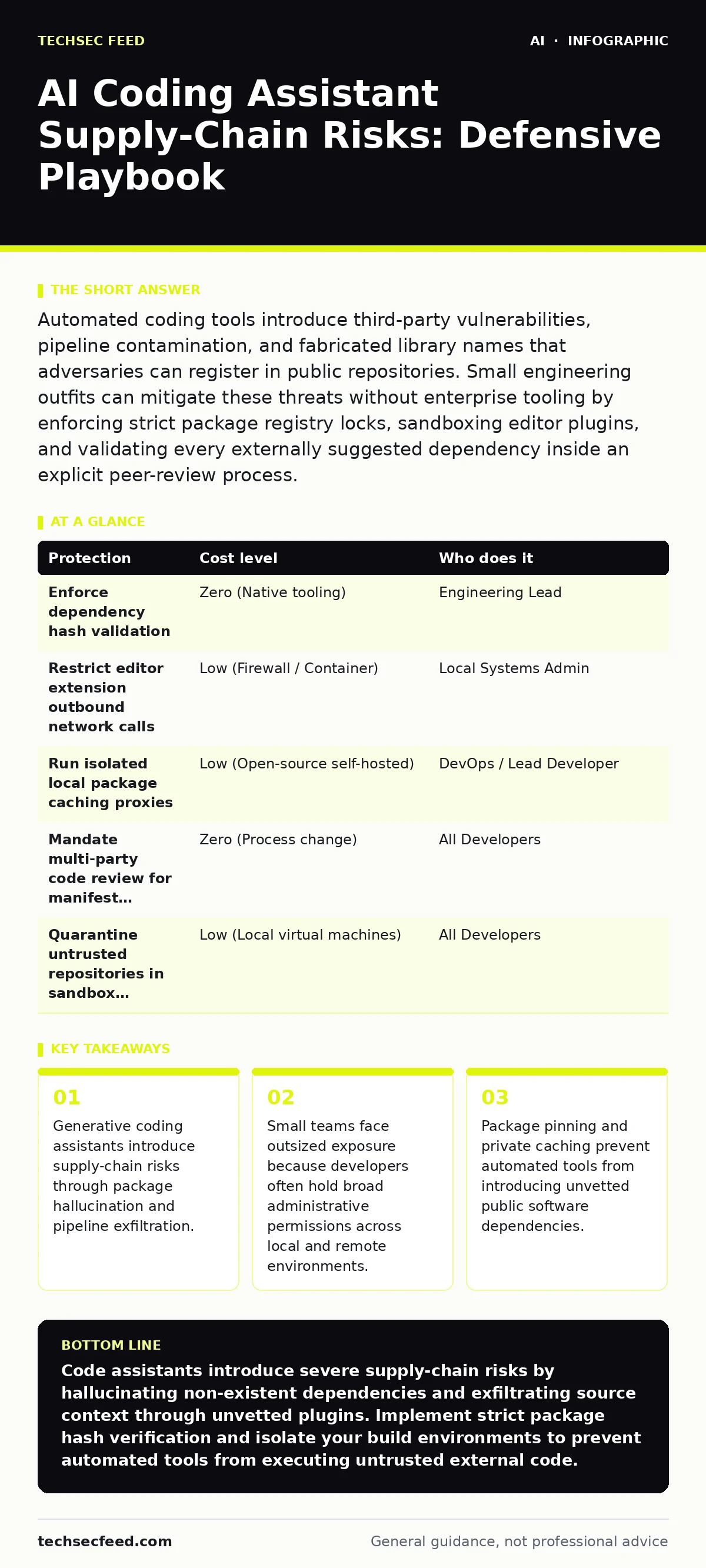
Automated coding tools introduce third-party vulnerabilities, pipeline contamination, and fabricated library names that adversaries can register in public repositories. Small engineering outfits can mitigate these threats without enterprise tooling by enforcing strict package registry locks, sandboxing editor plugins, and validating every externally suggested dependency inside an explicit peer-review process.
How Coding Assistants Turn Suggestions Into Supply-Chain Exposure
Machine-learning code generators produce syntax based on statistical probability rather than verified package registries. When an assistant suggests a third-party dependency, it frequently generates plausible names that do not actually exist in registries like PyPI or npm. Attackers continuously monitor failed downloads or common generated patterns to register those empty names with malicious payloads, turning a simple typo into a direct attack path.
Developers often accept generated suggestions without inspecting whether the referenced package is an authentic, maintained project. This behavior links directly to package hallucination, a failure mode discussed in detail in our work on AI hallucinations. The moment your build pipeline executes an automated dependency install, it pulls the attacker's newly registered payload into your internal execution chain.
Local workstation extensions create an additional vector by inspecting local file systems and open buffers. Plugins send telemetry, repository context, and environment variables back to remote model endpoints for inference. If an extension runs with unrestricted access, any compromised upstream server or malicious prompt embedded in an untrusted repository can manipulate the assistant into exfiltrating secrets.
Why Small Organizations Face Asymmetric Software Risk
Small engineering teams lack the dedicated build security personnel found in enterprise organizations. Developers routinely run local processes with administrative privileges, meaning a malicious package introduced by an editor plugin can read system memory, access private SSH keys, and alter local git configs. The assumption that smaller teams have simpler risk profiles fails because single developers often possess keys to production environments.
Staffing constraints also lead small teams to use default continuous integration pipelines that pull dependencies directly from the public internet on every build run. Without a local proxy or strict artifact repository, your build systems will silently download and execute whatever dependency name an assistant wrote into the project configuration file. Treating developers as trusted users while ignoring the untrusted nature of their tools creates a critical architectural blind spot.
Enforcing strict policies requires treating tools as outside contributors rather than internal utilities. Our analysis on treating AI models as untrusted insiders explains the structural mechanisms needed to isolate these agents. When a ten-person company adopts coding plugins without sandboxing, it inherits the supply-chain risks of every open-source repository ingested by the underlying model.
Low-Cost Controls for Development Environments
You can isolate code generators without purchasing expensive enterprise platforms. The defense starts by configuring package managers to disallow wildcards and require exact hash checks for all dependencies. A lockfile records the precise cryptographic hash and version of every accepted library, preventing an attacker's poisoned package from replacing a legitimate component during automated assembly.
Local plugin permissions require similar hardening. Most modern integrated development environments support running extensions inside isolated containers or restricted workspaces. Restricting extension network access ensures that assistant plugins cannot transmit source code snippets or local configuration files to unauthorized remote endpoints.
Enforce strict package verification without external tooling
npm config set save-exact=true
pip install --require-hashes -r requirements.txt
Establishing local artifact proxies offers another low-cost defense. By pointing your developer machines and continuous integration servers to a local package cache that only syncs approved, pre-existing libraries, you eliminate the risk of a developer pulling a freshly registered, malicious hallucinated package. If a dependency does not already exist inside your cache, the local build fails loudly before running external installation scripts.
Core Protections for Small Engineering Teams
Defending against automated supply-chain contamination requires balancing low budgets with developer workflow speed. The following controls reduce exposure across the code-generation lifecycle.
| Protection | Cost level | Who does it |
|---|---|---|
| Enforce dependency hash validation | Zero (Native tooling) | Engineering Lead |
| Restrict editor extension outbound network calls | Low (Firewall / Container) | Local Systems Admin |
| Run isolated local package caching proxies | Low (Open-source self-hosted) | DevOps / Lead Developer |
| Mandate multi-party code review for manifest changes | Zero (Process change) | All Developers |
| Quarantine untrusted repositories in sandbox environments | Low (Local virtual machines) | All Developers |
Adopting formal boundaries for code generation also requires clear internal expectations. Organizations should establish baseline behavioral expectations by establishing explicit AI usage policies at work. These policies ensure developers understand that generated configurations and dependencies carry the same liability as arbitrary code copied from public forums.
Questions to Ask an External IT or Managed Service Provider
Managed service providers and IT vendors often configure the baseline operating systems and network routes used by your developers. When auditing their controls, ask specific technical questions to understand your actual exposure:
- Which automated controls do you use to block development workstations from communicating with unregistered or recently registered external domains?
- How does your managed endpoint detection inspect local background processes spawned directly by code editor plugins?
- Do your default workstation configurations permit the automatic installation of unvetted extensions from open IDE marketplaces?
- What mechanisms do you provide to route internal package manager requests through a centralized, vetted repository instead of the public internet?
- How are development machines isolated from the broader corporate network when local web servers or test pipelines run locally?
Understanding these operational boundaries allows you to locate gaps before deploying assistants. If a provider cannot describe how they monitor child processes launched by developer tooling, you must assume editor plugins can execute commands without triggering standard endpoint alerts.
Validating Third-Party Components in the Pipeline
Detecting poisoned dependencies requires validating the age and provenance of every external library added to a repository. Attackers who exploit package hallucinations register names rapidly, meaning malicious packages are almost always newly created. Enforcing a minimum package age policy inside your continuous integration system stops recently uploaded components from entering active codebases.
Automated manifest reviews must treat library additions as high-risk events. When an assistant suggests adding a utility library, developers must verify that the upstream repository has an established release history, signed releases, and an active maintainer base. Incorporating these verification steps prevents the pipeline from pulling components created minutes prior to build execution.
You should also review internal repository rules to ensure no automated agent can commit directly to release branches. Pair this with standard operational oversight; our guide to AI governance provides templates for managing programmatic risk across software infrastructure. Code synthesis tools should only suggest logic; human engineers must retain absolute responsibility for dependency authorization.
Operational Boundaries for Generated Infrastructure Code
Coding assistants do not just write application logic; they also generate build scripts, container definitions, and cloud infrastructure files. A flawed configuration generated for an infrastructure-as-code template can silently weaken network borders, open public storage access, or disable container security flags. Small teams frequently adopt these infrastructure templates without validating the underlying permission models.
Sandboxing the execution of infrastructure scripts prevents broad credential compromises. Never run generated scripts using cloud accounts that possess root or broad administrative permissions. Assign distinct, temporary credentials limited to the specific resource being provisioned to ensure that an exploited script cannot alter identity policies across your entire cloud organization.
Treating generated deployment scripts as potentially hostile code insulates your downstream environments. Combine strict runtime isolation with constant monitoring to detect unusual configuration changes. Defending the development environment is useless if an assistant can manipulate deployment settings to introduce supply-chain vulnerabilities directly into production environments.
Key takeaways
- Generative coding assistants introduce supply-chain risks through package hallucination and pipeline exfiltration.
- Small teams face outsized exposure because developers often hold broad administrative permissions across local and remote environments.
- Package pinning and private caching prevent automated tools from introducing unvetted public software dependencies.
- Third-party IT providers must disclose how development plugins interact with external telemetry and central repositories.
Code assistants introduce severe supply-chain risks by hallucinating non-existent dependencies and exfiltrating source context through unvetted plugins. Implement strict package hash verification and isolate your build environments to prevent automated tools from executing untrusted external code.
Frequently asked questions
What is package hallucination in coding assistants?
Package hallucination occurs when an AI code generator suggests a dependency that does not exist in any official software registry. Attackers find these non-existent package names and register them with malicious payloads, which developers then accidentally install.
Can our team safely use code assistants without enterprise security software?
Yes, you can mitigate most risks using free, native tools by enforcing lockfiles with cryptographic hashes, disallowing wildcard versioning, and using local package proxies. Process changes, such as mandatory review for any dependency change, require zero budget.
Why do coding assistants pose a greater threat to small businesses than large enterprises?
Small businesses generally give developers broad administrative permissions on workstations and lack isolated build systems, meaning a single poisoned package can compromise the entire infrastructure. Larger firms typically isolate pipelines behind strict proxy caches and dedicated security operations.
How do editor extensions leak proprietary source code to external servers?
Many assistants transmit open file contents, surrounding repository files, and system paths to remote inference servers to generate accurate code completions. If an organization does not restrict plugin telemetry and network connections, proprietary code and local configuration secrets pass to third-party infrastructure.
How this guide was produced: written by the TechSec Feed editorial team with AI assistance, checked against the public references listed below, and reviewed when the facts change. See our editorial policy or report an error.