
What Happens If API Key Is Exposed: Real Risks and Fixes
An exposed API key grants immediate programmatic access to your data stores, often bypassing human-facing security controls and enabling silent data exfiltration before detection.
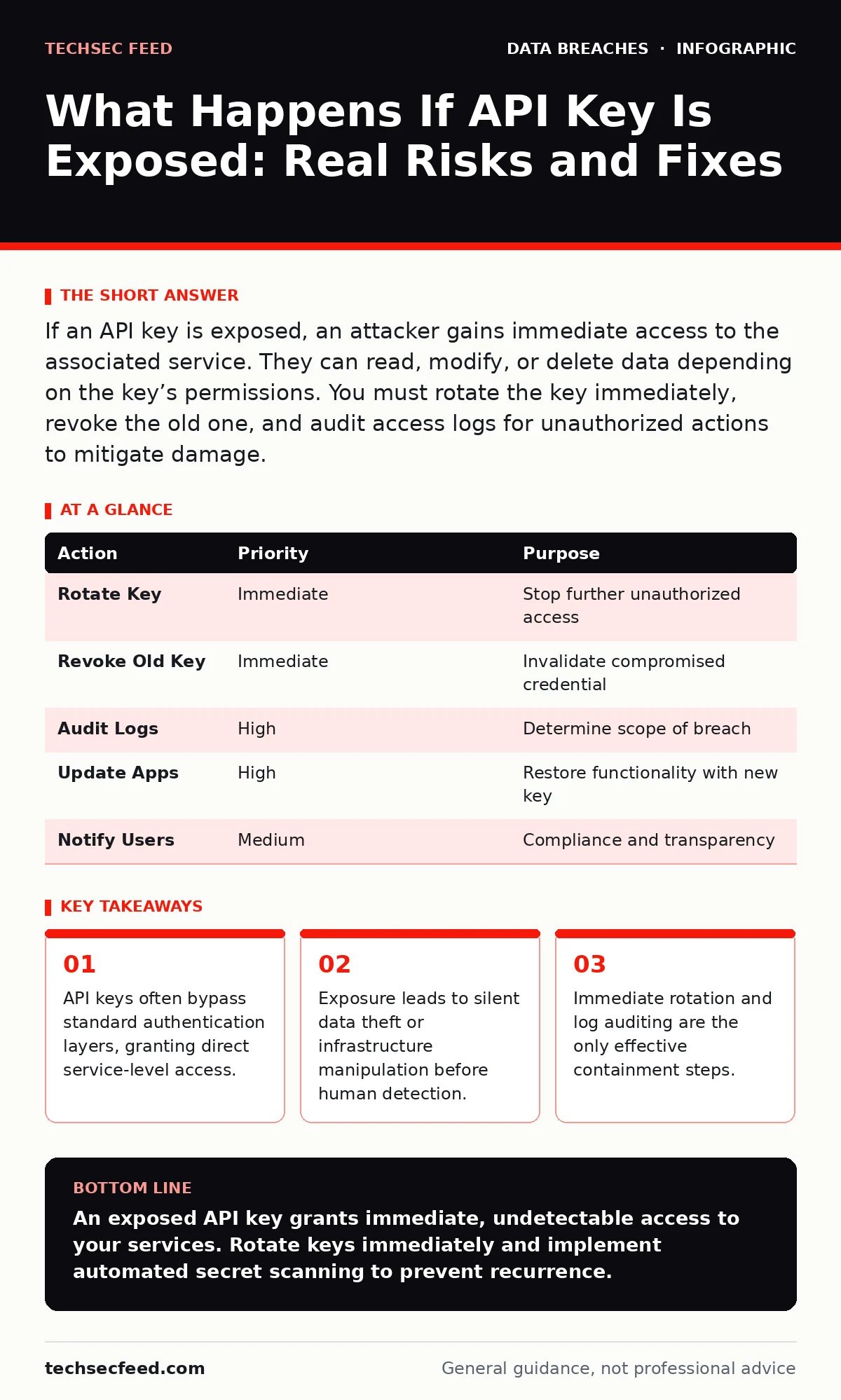
If an API key is exposed, an attacker gains immediate access to the associated service. They can read, modify, or delete data depending on the key’s permissions. You must rotate the key immediately, revoke the old one, and audit access logs for unauthorized actions to mitigate damage.
What happens if api key is exposed
An exposed API key allows any holder to authenticate as the associated service account. This is not a guessable password scenario. An API key is a static credential that grants specific permissions to a service. When leaked, it functions like a master key for that specific service. The attacker does not need to bypass firewalls or exploit software vulnerabilities. They simply present the key to the API endpoint. The service validates the key and grants access. This bypasses many network-level defenses that rely on source IP reputation or behavioral analysis of human users.
How quickly does exploitation occur
Exploitation often occurs within minutes of exposure. Automated bots constantly scan public repositories, paste sites, and cloud storage buckets for known API key patterns. These bots operate 24 hours a day. They do not sleep. They do not require social engineering. Once a bot finds a valid key, it tests it against common endpoints. If the key is active and has write permissions, the bot can begin data exfiltration or resource abuse immediately. You cannot rely on a delay between exposure and compromise. The window for silent theft is extremely narrow.
What can an attacker do with a valid key
The damage depends entirely on the scope of permissions granted to the key. A read-only key allows data scraping and intellectual property theft. A write-enabled key allows data modification, deletion, or injection of malicious code. An administrative key allows infrastructure changes, such as creating new user accounts or spinning up expensive cloud resources. Attackers often use exposed keys to mine cryptocurrency or run botnets using your cloud infrastructure. This results in significant financial loss and potential legal liability. The attacker acts as a legitimate user, making their actions hard to distinguish from normal operations.
Why standard security tools miss API abuse
Traditional intrusion detection systems focus on network traffic patterns and known attack signatures. API abuse looks like legitimate traffic. The requests come from valid endpoints. The authentication is valid. The payload structure is correct. Only the intent is malicious. This makes behavioral anomaly detection critical. You must monitor for unusual volume, geographic location, or time of day for API calls. Standard firewall rules do not inspect the content of authenticated API requests. They assume the authentication layer has already validated the user. This assumption fails when the credential itself is compromised.
How to detect an exposed key early
Detection requires continuous monitoring of source code and deployment artifacts. You must scan public and private repositories for hardcoded secrets. You must monitor cloud storage buckets for accidental uploads of configuration files. You must review access logs for spikes in activity or requests from unfamiliar IP addresses. Implementing a secret management system reduces the risk of hardcoded keys. This system stores keys securely and injects them at runtime. It prevents keys from appearing in version control history. Regular audits of service accounts ensure permissions are minimal.
See also: Data Breach Response Plans: Real Value vs Operational Limits · What is Hard Disk Encryption and How It Protects Data
What to do immediately after discovery
Rotate the exposed key immediately. Generate a new key and update all applications using the old one. Revoke the old key to invalidate it. Do not wait for the next maintenance window. Immediate revocation stops further unauthorized access. Audit access logs to determine what actions were taken with the exposed key. Look for data exports, configuration changes, or new resource creation. Identify any data that may have been compromised. Notify affected parties if sensitive data was accessed. Document the incident for future review. This process limits the blast radius of the exposure.
| Action | Priority | Purpose |
|---|---|---|
| Rotate Key | Immediate | Stop further unauthorized access |
| Revoke Old Key | Immediate | Invalidate compromised credential |
| Audit Logs | High | Determine scope of breach |
| Update Apps | High | Restore functionality with new key |
| Notify Users | Medium | Compliance and transparency |
How to prevent future exposure
Prevention requires a cultural shift toward treating secrets as infrastructure. Never hardcode API keys in source code. Use environment variables or secret management tools. Restrict access to secret storage to authorized personnel only. Implement least privilege principles for all service accounts. Regularly review and rotate keys even if no breach is suspected. Educate developers on the risks of committing secrets to version control. Use pre-commit hooks to scan for secrets before code is pushed. This automated check prevents accidental exposure at the source.
The hidden cost of key exposure
The cost extends beyond immediate data loss. It includes the time spent investigating the breach. It includes the cost of notifying affected users. It includes the reputational damage to your organization. It includes the legal fees if regulatory compliance is violated. It includes the opportunity cost of diverted engineering resources. These costs are often higher than the direct financial loss. They erode trust with customers and partners. Rebuilding that trust takes significant effort and time. Prevention is always cheaper than remediation.
Related security considerations
Understanding API key exposure helps contextualize other security risks. See our guide on data scraping to understand how attackers harvest exposed information. Review encryption in transit to ensure data is protected during movement. Consider encryption at rest to protect data if storage is compromised. Learn about incident communication plans to prepare for breach notification. Understand the CIA triad to prioritize confidentiality, integrity, and availability. These concepts work together to form a defense-in-depth strategy. No single control is sufficient. You must layer protections to reduce risk.
Key takeaways
- API keys often bypass standard authentication layers, granting direct service-level access.
- Exposure leads to silent data theft or infrastructure manipulation before human detection.
- Immediate rotation and log auditing are the only effective containment steps.
An exposed API key grants immediate, undetectable access to your services. Rotate keys immediately and implement automated secret scanning to prevent recurrence.
Frequently asked questions
Can I just change the password if an API key is leaked?
No. API keys are distinct from user passwords. You must rotate the specific API key in the service provider's console. Changing a user password does not invalidate an API key.
How do I know if my API key is already exposed?
Search public code repositories and paste sites for your key. Use automated secret scanning tools. Monitor access logs for unusual activity. If you suspect exposure, assume it is exposed and rotate the key.
Should I use the same API key for development and production?
Never. Use separate keys for different environments. This limits the blast radius of a leak. A compromised development key should not grant access to production data or resources.
What is the best way to store API keys?
Use a dedicated secret management service. These services encrypt keys at rest and provide audit logs. They inject keys into applications at runtime, preventing them from being stored in code or configuration files.
How this guide was produced: written by the TechSec Feed editorial team with AI assistance, checked against the public references listed below, and reviewed when the facts change. See our editorial policy or report an error.