
API Key Security: How to Protect Secrets Without Leaking Access
Static API keys never expire by design, meaning a single leaked credential can grant indefinite access until you manually revoke it and rotate every service that uses it.
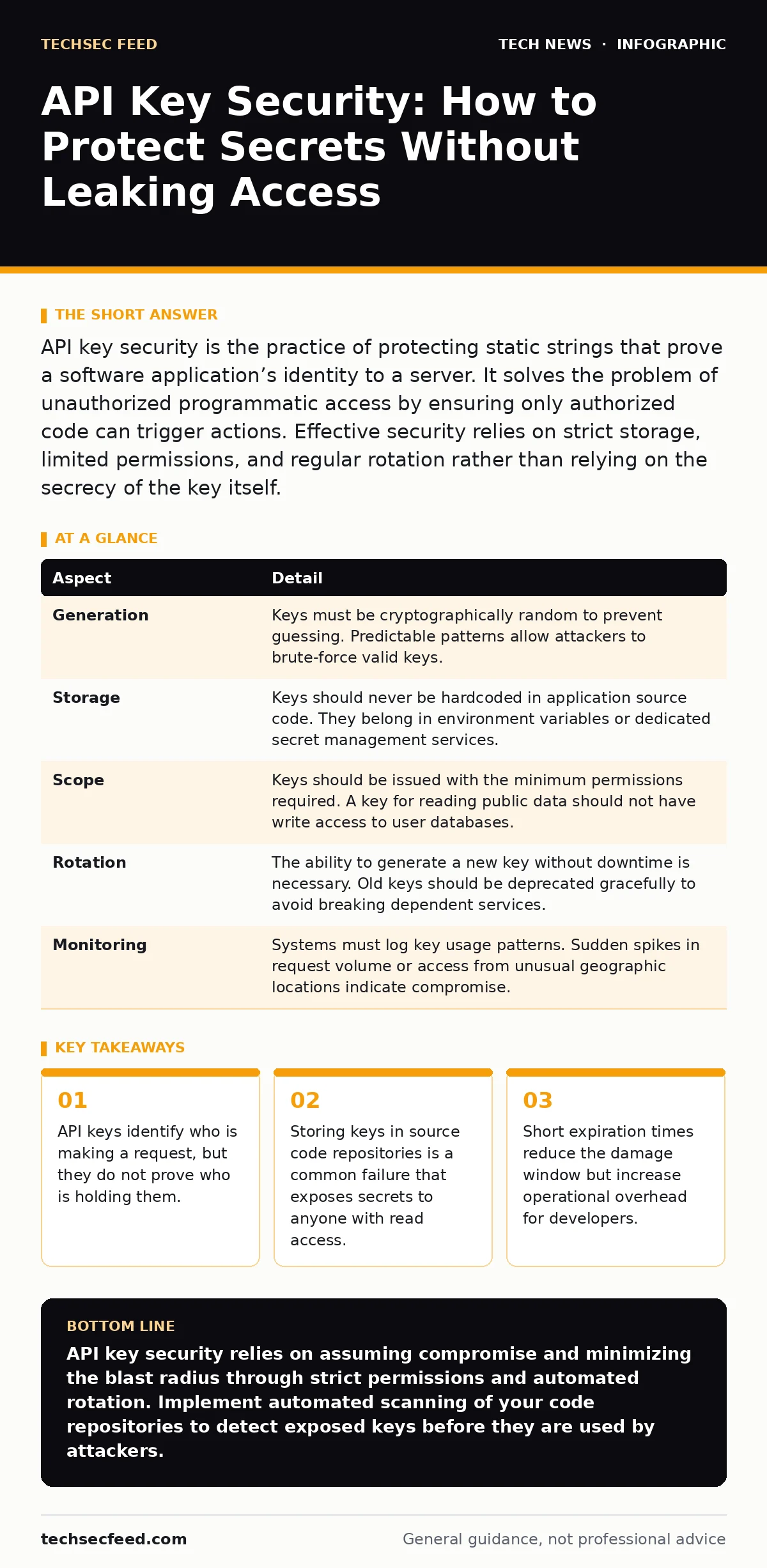
API key security is the practice of protecting static strings that prove a software application’s identity to a server. It solves the problem of unauthorized programmatic access by ensuring only authorized code can trigger actions. Effective security relies on strict storage, limited permissions, and regular rotation rather than relying on the secrecy of the key itself.
The Hotel Key Card Analogy
Imagine a hotel key card. It grants you entry to your specific room and perhaps the gym. It does not prove you are the guest; it only proves you possess the card. If you lose the card, the front desk must cancel it and issue a new one. Until then, anyone finding that card can enter your room.
API keys function similarly in the digital world. They are static strings of characters that allow software to authenticate with another service. Unlike a password, which usually involves a human user typing credentials, an API key is used by machines talking to machines. The security model assumes the key is secret, but in practice, the key often travels through logs, configuration files, and public code repositories.
The core problem is that these keys rarely expire. A password might be forced to change every ninety days. An API key remains valid until an administrator explicitly revokes it. This permanence creates a persistent attack surface. If a key leaks, the attacker has a permanent back door until you detect the leak, revoke the key, and generate a new one across all affected systems.
What API Key Security Actually Solves
The primary purpose of API key security is to prevent unauthorized programmatic access. When an application sends a request to a server, the server needs to know if the application is allowed to perform that action. The API key serves as the initial proof of identity.
This mechanism solves the problem of anonymous abuse. Without keys, a server cannot distinguish between legitimate traffic from your partner application and a script scanning for vulnerabilities. By requiring a valid key, the server can filter out unknown clients before they consume resources or attempt sensitive operations.
However, the key alone does not guarantee security. It only identifies the source. It does not encrypt the data in transit. That responsibility falls to protocols like HTTPS, which secures the communication channel. The API key sits inside that encrypted tunnel, preventing eavesdroppers from stealing it during transmission, but it does nothing to protect the key if it is stored poorly on the client side.
The Anatomy of Key Management
Effective management requires treating keys as sensitive infrastructure, not just configuration values. The process involves generation, storage, usage, and rotation. Each step introduces potential failure points that must be addressed explicitly.
| Aspect | Detail |
|---|---|
| Generation | Keys must be cryptographically random to prevent guessing. Predictable patterns allow attackers to brute-force valid keys. |
| Storage | Keys should never be hardcoded in application source code. They belong in environment variables or dedicated secret management services. |
| Scope | Keys should be issued with the minimum permissions required. A key for reading public data should not have write access to user databases. |
| Rotation | The ability to generate a new key without downtime is necessary. Old keys should be deprecated gracefully to avoid breaking dependent services. |
| Monitoring | Systems must log key usage patterns. Sudden spikes in request volume or access from unusual geographic locations indicate compromise. |
The most critical component is scope. Many organizations issue keys with broad permissions because it is easier to debug. This creates a high-impact risk. If a key with broad permissions leaks, the attacker can perform any action the application can perform. Limiting the scope ensures that even a leaked key has limited utility.
The Hidden Cost of Static Credentials
The usual advice is to keep keys secret. This is insufficient because keys inevitably leak. The non-obvious consequence of using static keys is the operational burden of detection. You are not securing the key against theft; you are securing your ability to react when theft occurs.
Consider the lifecycle of a key. It is generated, embedded in an application, deployed to a server, and potentially committed to a version control system by mistake. Once committed, that key is public. Even if you remove it from the repository, the history remains. Anyone who clones the repository can find the key in the commit history.
This is why secure software development practices must include automated scanning of code repositories for secret patterns. Manual review is unreliable. Developers are focused on logic, not on spotting a six-character prefix that resembles an API key. Automated tools can flag these patterns before the code is merged, preventing the leak at the source.
Common Misconceptions in Key Security
Many teams treat API keys like passwords. This is a fundamental error. Passwords protect human accounts and are subject to complexity requirements and regular expiration policies. API keys protect application identities and are often long-lived. Applying password policies to API keys breaks automation.
Another mistake is assuming that encryption at rest solves the problem. Encrypting a database of API keys is good practice, but it does not help if the keys are exposed in application logs or memory dumps. The key must be protected in every state: at rest, in transit, and in use.
A third misconception is that rate limiting replaces authentication. Rate limiting restricts how many requests a key can make, but it does not verify that the key holder is authorized. An attacker with a valid key can still perform actions, just slowly. Rate limiting is a mitigation strategy, not a security control.
See also: Encryption at Rest: The Hidden Gaps in Data Protection
Integrating with Broader Defenses
API key security does not exist in isolation. It must work in tandem with other security controls. For instance, the OSI model helps visualize where keys fit. Keys operate at the application layer, providing identity. Lower layers provide transport security and network access control.
When designing systems, consider how keys interact with certificate authorities. In mutual TLS, both the client and server present certificates. This provides a stronger form of authentication than API keys alone. However, API keys are simpler to implement and manage for third-party integrations. The trade-off is security versus convenience.
The Reality of Key Rotation
Rotation is the most difficult aspect of key security. Changing a key requires updating every system that uses it. If those systems are not tracked, rotation causes outages. The hidden cost of frequent rotation is operational complexity.
Teams often avoid rotation because it is painful. This leads to keys remaining valid for years. The longer a key lives, the higher the probability of leakage. The solution is not to rotate keys more often, but to make rotation easier. Implementing a system that supports multiple active keys allows you to introduce a new key before deprecating the old one.
This approach reduces the risk of downtime. You can monitor the new key to ensure it works correctly before disabling the old one. It also provides a window to detect if the old key was compromised. If you see requests on the old key after deprecation, you know it was leaked.
Conclusion of Practices
Securing API keys requires a shift in mindset. You cannot prevent all leaks. You must assume leaks will happen and design your systems to minimize the damage. This means strict scoping, automated detection, and easy rotation.
By treating keys as dynamic, monitored entities rather than static secrets, you reduce the window of exposure. The goal is not to make the key unbreakable, but to make it useless to an attacker. This aligns with broader security principles found in frameworks like IPv6 security, where defense in depth is prioritized over single-point failures.
Key takeaways
- API keys identify who is making a request, but they do not prove who is holding them.
- Storing keys in source code repositories is a common failure that exposes secrets to anyone with read access.
- Short expiration times reduce the damage window but increase operational overhead for developers.
API key security relies on assuming compromise and minimizing the blast radius through strict permissions and automated rotation. Implement automated scanning of your code repositories to detect exposed keys before they are used by attackers.
Frequently asked questions
How long should an API key remain valid?
There is no universal standard, but keys used for sensitive operations should be rotated quarterly. Keys for public read-only access may remain valid longer, but they should still be monitored for abuse.
Can I use the same API key for development and production?
No. Development and production environments should have separate keys. This prevents accidental changes in production from development tests and limits the damage if a development key is leaked.
What is the difference between an API key and an access token?
An API key is a static secret used to identify an application. An access token is a short-lived credential issued after authentication, often containing specific permissions and an expiration time. Tokens are safer for user-facing interactions.
How do I detect if my API key has been leaked?
Monitor your API logs for unusual activity, such as requests from unexpected IP addresses or high volumes of traffic. Automated tools can also scan public repositories and paste sites for known key patterns.
How this guide was produced: written by the TechSec Feed editorial team with AI assistance, checked against the public references listed below, and reviewed when the facts change. See our editorial policy or report an error.