
Consent Management: Definition, Mechanics and Hidden Costs
Consent management is a technical protocol that records user permission, not just a legal checkbox that satisfies regulators after the fact.
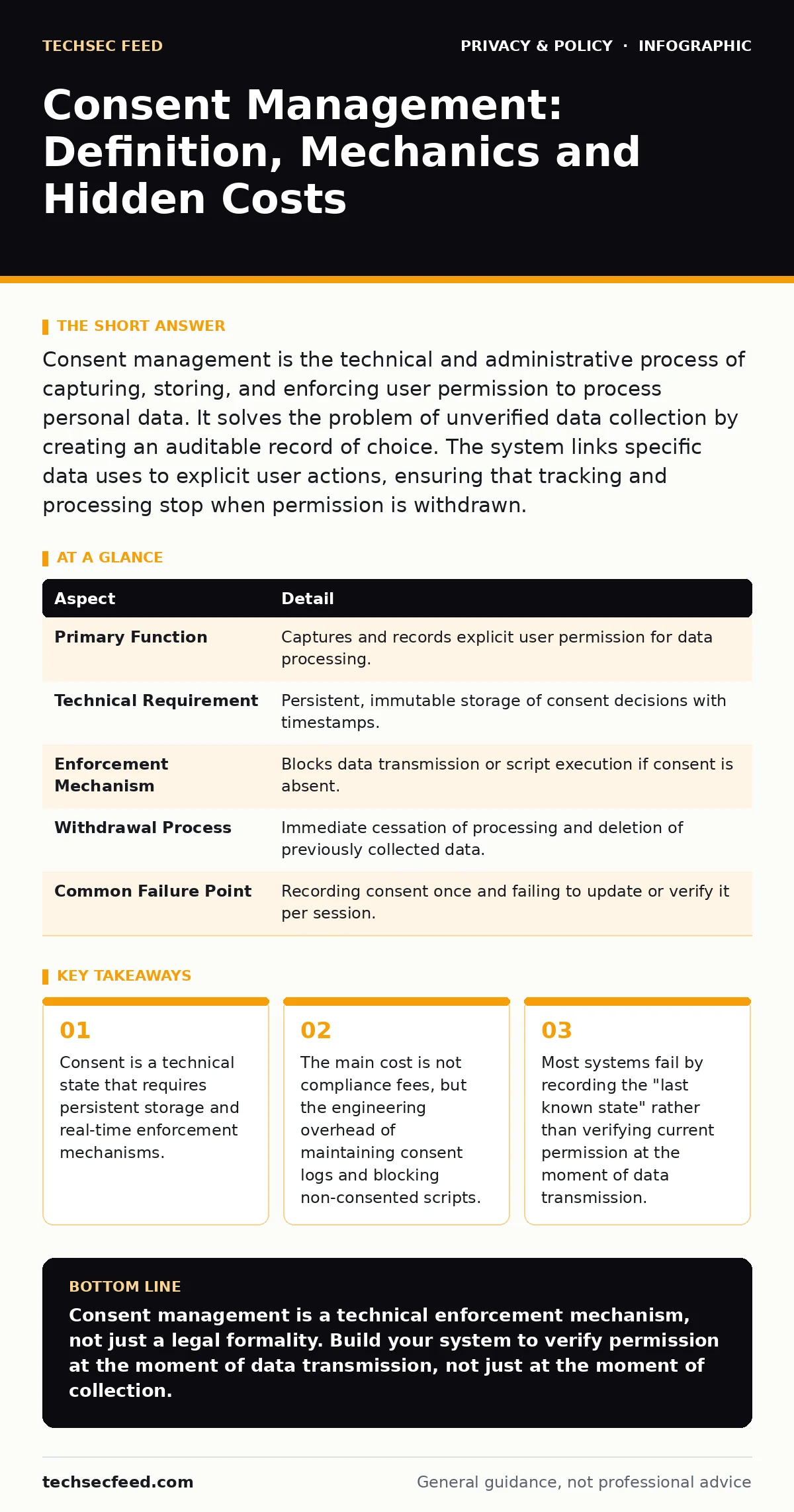
Consent management is the technical and administrative process of capturing, storing, and enforcing user permission to process personal data. It solves the problem of unverified data collection by creating an auditable record of choice. The system links specific data uses to explicit user actions, ensuring that tracking and processing stop when permission is withdrawn.
The Library Card Analogy
Imagine a library that lets you borrow books without checking out. You take a novel, read it, and leave. The librarian assumes you still have it because you never returned it. This assumption creates chaos. The library cannot track inventory, and you cannot prove you returned the item if accused of theft.
Consent management operates on the opposite principle. It is the checkout system. It requires a deliberate action to take the book, records exactly when you took it, and allows you to return it at any time. The system updates instantly. If you return the book, the library’s record changes immediately. You cannot borrow another book using the same permission slip.
In digital terms, the book is your personal data. The checkout desk is the consent management platform. The act of borrowing is the collection and processing of that data. Without this system, organizations operate on assumptions rather than verified permissions.
The Problem of Assumed Permission
Many systems collect data by default. They assume that because a user visited a site or installed an app, they agree to have their behavior tracked. This assumption is legally and technically fragile. It creates a gap between what the user expects and what the system does.
The core problem is verification. An organization must prove that a specific user agreed to a specific data use at a specific time. Without a structured record, this proof does not exist. If a user claims they never agreed, the organization has no objective evidence to refute the claim.
This lack of verification leads to data hoarding. Systems collect everything because they cannot easily distinguish between permitted and unpermitted data. This increases storage costs and expands the attack surface for data breaches. Every byte of unverified data is a liability.
At a Glance
| Aspect | Detail |
|---|---|
| Primary Function | Captures and records explicit user permission for data processing. |
| Technical Requirement | Persistent, immutable storage of consent decisions with timestamps. |
| Enforcement Mechanism | Blocks data transmission or script execution if consent is absent. |
| Withdrawal Process | Immediate cessation of processing and deletion of previously collected data. |
| Common Failure Point | Recording consent once and failing to update or verify it per session. |
The Main Components
A functional system relies on three distinct layers. The first layer is the interface. This is the banner, modal, or settings page where the user makes a choice. It must present clear options. Vague language or hidden defaults invalidate the consent. The interface must reflect the current state of permission, not a cached state from a previous visit.
The second layer is the storage engine. This component records the decision. It must store who consented, what they consented to, when they consented, and how they consented. This record must be tamper-proof. If the record can be altered by the organization, it holds no evidentiary weight. This storage often integrates with identity management systems to link the decision to a specific user profile.
The third layer is the enforcement gateway. This is the technical mechanism that stops data flow. It checks the storage engine before allowing a script to run or a pixel to fire. If the record shows no consent for a specific vendor or purpose, the gateway blocks the request. This layer is where most implementations fail, as many systems record consent but do not actively block non-consented data transmission.
Where Consent Fits in Defense
Consent management is not a standalone shield. It is a control layer within a broader privacy architecture. It sits between the user’s interaction and the data processing backend. It works alongside privacy audits to ensure that the data flows described in the consent banner actually match the technical reality. If the audit reveals tracking that was not disclosed, the consent is invalid.
It also intersects with data subject access requests. When a user asks to see what data you hold, the consent log provides the legal basis for holding that data. If you cannot produce a valid consent record, you must delete the data. This link turns consent logs into a defensive tool during regulatory inquiries.
For organizations dealing with sensitive information, consent management complements anonymization techniques. If data is truly anonymized, consent is often not required because the data is no longer linked to an individual. However, achieving true anonymization is difficult. Consent management handles the data that remains personally identifiable. It does not replace facial recognition risks mitigation, but it ensures that if biometric processing occurs, it is explicitly authorized.
See also: Data Subject Access Requests: Mechanism, Limits and Hidden Costs
What People Usually Get Wrong
The most common error is treating consent as a one-time event. Organizations implement a banner, capture the click, and move on. They fail to recognize that consent is a continuous state. Users change their minds. Browsers clear cookies. Devices change. The system must re-verify permission at regular intervals or at the start of each significant session.
Another mistake is conflating consent with notice. Posting a privacy policy is not consent. Consent requires an affirmative action. Pre-checked boxes do not count. Silence does not count. The user must actively choose to opt in. This distinction is technical, not just legal. The system must be built to require a positive signal.
The Hidden Cost of Granularity
Implementing fine-grained consent introduces engineering complexity. When users can choose to allow analytics but reject advertising, the system must manage dozens of separate permission flags. Each flag must be checked by every data processor. This adds latency to page loads and increases the risk of configuration errors.
This granularity also complicates data retention. If a user consents to analytics but not marketing, the system must ensure that analytics data is not inadvertently used for marketing purposes. This requires strict data segmentation. Failure to segment data correctly leads to privacy violations, even if consent was initially granted.
The cost is not just in development. It is in ongoing maintenance. As new vendors are added or purposes change, the consent interface and backend logic must be updated. This creates a perpetual cycle of validation. Organizations often underestimate this operational burden, leading to technical debt that accrues interest in the form of compliance risks.
Integrating with Identity and Access
Consent management must align with file metadata practices. When data is exported or shared, the consent status should travel with the data. This ensures that downstream processors respect the original permissions. Without this linkage, data can leak into systems that lack the appropriate consent checks.
For smaller entities, the complexity can be overwhelming. Privacy laws for small businesses often have exemptions or simplified requirements, but the technical implementation remains challenging. Small teams may lack the resources to build custom enforcement gateways. They often rely on third-party frameworks, which introduces dependency risks. If the framework fails, the entire consent structure collapses.
The system must also handle edge cases, such as users who disable JavaScript or use people-search sites that aggregate public data. These channels often bypass traditional consent mechanisms. Organizations must recognize that consent management covers data they collect directly, but may not fully control data aggregated by third parties. This limitation requires a broader strategy that includes data minimization and regular privacy audits.
Key takeaways
- Consent is a technical state that requires persistent storage and real-time enforcement mechanisms.
- The main cost is not compliance fees, but the engineering overhead of maintaining consent logs and blocking non-consented scripts.
- Most systems fail by recording the "last known state" rather than verifying current permission at the moment of data transmission.
Consent management is a technical enforcement mechanism, not just a legal formality. Build your system to verify permission at the moment of data transmission, not just at the moment of collection.
Frequently asked questions
Does consent management replace the need for a privacy policy?
No. A privacy policy explains what you do with data. Consent management captures the user’s agreement to those practices. Both are required for compliance.
Can I use a simple checkbox for consent?
Only if the checkbox is unchecked by default and requires an affirmative click. Pre-checked boxes or implied consent through continued browsing are generally invalid.
How long must I store consent records?
You must store them as long as you process the data based on that consent, plus any period required by local law for evidentiary purposes.
What happens if a user withdraws consent?
You must stop processing their data for that purpose immediately and delete any data collected under that consent, unless another legal basis exists.
How this guide was produced: written by the TechSec Feed editorial team with AI assistance, checked against the public references listed below, and reviewed when the facts change. See our editorial policy or report an error.