
IPv6 Security: Benefits, Limits, and When to Migrate
IPv6 removes the need for NAT, which simplifies architecture but exposes every device directly to the internet, requiring a shift from perimeter defense to host-level controls.
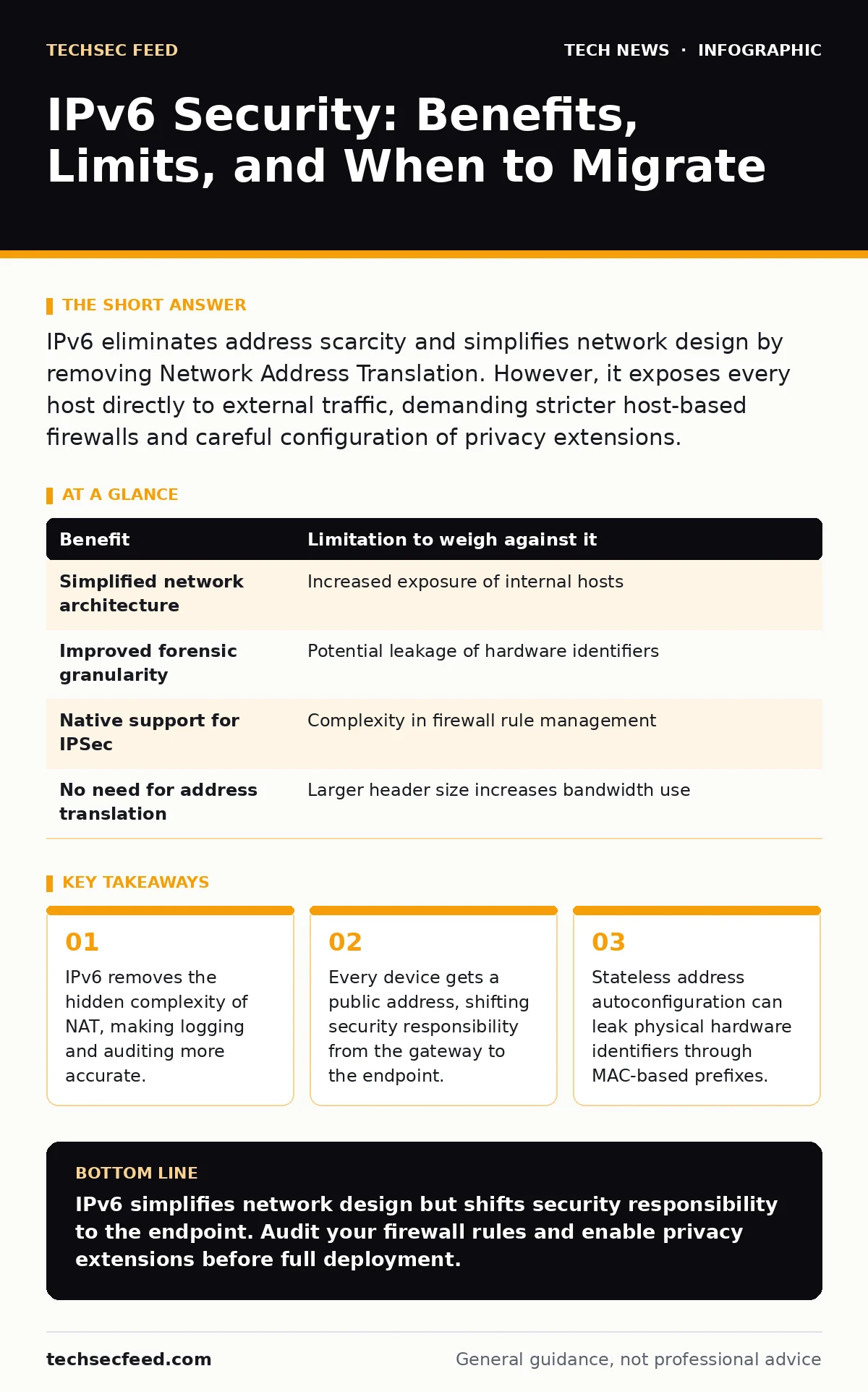
IPv6 eliminates address scarcity and simplifies network design by removing Network Address Translation. However, it exposes every host directly to external traffic, demanding stricter host-based firewalls and careful configuration of privacy extensions.
The End of Network Address Translation
Network Address Translation, or NAT, allows multiple devices to share a single public IP address. It acts as a gatekeeper, hiding internal network structures from the outside world. IPv6 eliminates this necessity by providing a vast address space. You no longer need to map private addresses to a public one.
This change simplifies network topology significantly. Troubleshooting becomes easier because packet headers remain intact from source to destination. You can trace the origin of traffic without deciphering complex translation tables. However, this transparency comes with a trade-off. Every device on your network now has a globally routable address.
The assumption that internal devices are safe behind a NAT firewall no longer holds. An attacker can target any host directly if routing is misconfigured. You must treat every endpoint as a potential entry point. This requires a fundamental shift in how you design your security controls.
Visibility and Audit Accuracy
One of the most overlooked benefits of IPv6 is improved visibility. With NAT, multiple users or devices share an IP, obscuring individual activity logs. In an IPv6 environment, each device has a unique identifier. This granularity enhances forensic analysis and compliance reporting.
You can attribute actions to specific machines rather than a shared gateway. This precision helps in identifying compromised hosts faster. It also reduces the noise in security information and event management systems. Alerts are more specific, reducing false positives.
However, this visibility creates a new risk. If you do not manage your logging infrastructure correctly, you may expose sensitive internal mapping data. Attackers can use these logs to understand your network layout. Ensure your log retention policies are strict. Review your SIEM configuration to balance visibility with privacy.
The Risk of Autoconfiguration
IPv6 uses Stateless Address Autoconfiguration to assign addresses without a central server. This convenience can lead to security gaps if not managed. Devices generate addresses based on their MAC address, a unique hardware identifier. This linkage allows attackers to track devices across different networks.
Imagine a user connecting to various Wi-Fi networks. Their MAC-based IPv6 address remains consistent. An adversary can correlate this address with other data to build a profile. To mitigate this, enable privacy extensions on all client devices. These extensions generate temporary, random addresses for outgoing connections.
You must verify that your operating systems are configured to use these temporary addresses by default. Many modern systems do this automatically, but older devices may not. Check your device policies regularly. This step prevents long-term tracking and reduces the attack surface for reconnaissance.
| Benefit | Limitation to weigh against it |
|---|---|
| Simplified network architecture | Increased exposure of internal hosts |
| Improved forensic granularity | Potential leakage of hardware identifiers |
| Native support for IPSec | Complexity in firewall rule management |
| No need for address translation | Larger header size increases bandwidth use |
Firewall Complexity Increases
IPv6 headers are more complex than IPv4 headers. They include extension headers that can carry additional data. Firewalls must parse these headers correctly to filter traffic. Misconfigured firewalls may drop legitimate traffic or allow malicious payloads through.
You need to ensure your firewall supports all IPv6 extension headers. Some older firewalls do not handle them well. This can lead to unexpected behavior during security audits. Test your firewall rules thoroughly with both IPv4 and IPv6 traffic.
Do not assume that your existing IPv4 rules translate directly. IPv6 requires specific rules for neighbor discovery and router advertisements. You must explicitly allow or deny these protocols. A default-deny policy is critical. Ensure that only necessary services are exposed to the internet.
Integration with Existing Security Models
IPv6 integrates well with modern security frameworks. For example, HTTPS works seamlessly over IPv6, ensuring encrypted communications. You do not need to change your certificate management processes. The same certificate authorities validate your domains regardless of the IP version.
However, you must update your security monitoring tools. Some intrusion detection systems may not fully support IPv6 traffic analysis. Ensure your tools can parse IPv6 packets correctly. This includes checking for anomalies in extension headers.
Consider how IPv6 interacts with DevOps security practices. Automated deployment pipelines must handle IPv6 configurations correctly. Test your applications in IPv6-only environments to catch issues early. This ensures resilience as you migrate away from IPv4.
When It Is Worth It
Migrating to IPv6 is worth it when you need scalability. If your organization plans to expand its IoT footprint, IPv6 is necessary. Each sensor or device can have a unique address. This simplifies management and reduces the need for complex subnets.
It is also worth it for improved security visibility. If you struggle with NAT-related logging issues, IPv6 offers a cleaner solution. You can audit individual device behavior more accurately. This is particularly useful for compliance-heavy industries.
Finally, it is worth it for future-proofing. IPv4 address pools are exhausted. New services and providers may only support IPv6. By migrating now, you avoid being locked out of new technologies. You maintain compatibility with the evolving internet infrastructure.
When It Is Not
IPv6 may not be worth it if your infrastructure is small and static. If you have only a few devices and no plans to expand, the complexity of managing dual-stack networks may outweigh the benefits. The effort to configure firewalls and test applications can be significant.
It is also not worth it if your security team lacks IPv6 expertise. Misconfiguration is a major risk. If you cannot ensure proper firewall rules and privacy extensions, you may expose your network to greater risk than with IPv4. Training and documentation are prerequisites.
Finally, do not migrate if your critical applications do not support IPv6. Some legacy systems may fail or behave unpredictably. You must test all applications thoroughly. If you cannot guarantee compatibility, stick with IPv4 until you can manage the transition safely.
Managing the Transition Period
The transition from IPv4 to IPv6 is rarely instant. Most networks operate in a dual-stack mode, supporting both protocols. This adds complexity to your security posture. You must manage two sets of rules, two sets of logging, and two sets of monitoring tools.
Ensure that your security policies are consistent across both stacks. A vulnerability in one stack can compromise the entire network. Regular audits are necessary to identify discrepancies. Check that updates are applied to both IPv4 and IPv6 configurations.
Monitor for tunneling protocols that may bypass your security controls. Some attackers use IPv6 tunnels to hide traffic from IPv4-only firewalls. Detect and block unauthorized tunneling attempts. This ensures that your perimeter defense remains effective during the transition.
Key takeaways
- IPv6 removes the hidden complexity of NAT, making logging and auditing more accurate.
- Every device gets a public address, shifting security responsibility from the gateway to the endpoint.
- Stateless address autoconfiguration can leak physical hardware identifiers through MAC-based prefixes.
IPv6 simplifies network design but shifts security responsibility to the endpoint. Audit your firewall rules and enable privacy extensions before full deployment.
Frequently asked questions
Does IPv6 replace the need for firewalls?
No, firewalls are still necessary. IPv6 exposes every host directly, making host-based firewalls and strict perimeter rules even more critical for filtering unwanted traffic.
Can I use IPv6 with my existing HTTPS setup?
Yes, HTTPS works over IPv6 without changes to your certificates. You may need to update your DNS records and firewall rules to allow IPv6 traffic, but the encryption layer remains the same.
How do I prevent MAC address tracking in IPv6?
Enable privacy extensions on all client devices. This feature generates temporary, random addresses for outgoing connections, preventing attackers from linking your hardware identifier to your online activity.
Is IPv6 more secure than IPv4?
Not inherently. IPv6 offers better visibility and native IPSec support, but it also exposes more hosts to the internet. Security depends on proper configuration, firewall rules, and endpoint hardening.
How this guide was produced: written by the TechSec Feed editorial team with AI assistance, checked against the public references listed below, and reviewed when the facts change. See our editorial policy or report an error.