How does IPv6 improve security and simplify packet routing
Native cryptographic protections and vastly expanded address spaces fundamentally alter how networks defend against reconnaissance.
How does IPv6 improve security? It bakes cryptographic authentication directly into the protocol suite and eliminates the reliance on fragile translation tricks. These native capabilities remove entire classes of packet manipulation vulnerabilities while forcing defenders to monitor vastly larger topologies.
How does IPv6 improve security at the protocol level
How does IPv6 improve security by design stems from its clean-slate architecture, which abandons legacy baggage inherited from older internet protocols. You gain an infrastructure built from the ground up to support cryptographic verification without relying entirely on external utilities. Protocol designers integrated these defenses to prevent common packet injection methods that plagued earlier network layers. Network address translation traditionally masked internal topology flaws, but the newer standard handles routing differently.
Stage 1: Protocol parsing and header simplification
Stage 1: Fixed header structures
Fixed header structures eliminate variable-length fields that historically confused intermediate routing hardware and created buffer overflow vectors. Processing engines handle packets faster because every header shares an identical length, reducing computational overhead during deep packet inspection. You remove parsing anomalies that adversaries previously exploited by crafting malformed packets designed to crash legacy network stacks. Operating system kernels benefit directly from this predictable layout when allocating memory buffers for incoming traffic streams.
Stage 1: Extension header chains
Extension header chains manage optional network-layer information separately from the primary routing instructions, keeping core transit paths clean and efficient. Routers examine only the base header while destination nodes process subsequent chained options like routing directives or fragmentation controls. You isolate administrative metadata away from the primary payload, though improperly chained extensions can occasionally trick inspection firewalls into missing malicious traffic. Adversaries sometimes abuse these chains to slip payloads past poorly configured security monitors, turning a modular design feature into a filtering challenge.
Stage 2: Address allocation and neighbor discovery
Stage 2: Expanded identifier spaces
Expanded identifier spaces provide roughly three hundred forty undecillion unique addresses, making brute-force reconnaissance sweeps functionally impossible against properly configured subnets. Traditional scanning scripts that easily mapped entire enterprise environments in minutes now face search spaces larger than the visible universe. You no longer need network address translation to conserve public identifiers, which restores end-to-end visibility for auditing tools. However, predictable interface identifiers derived from hardware media access control addresses can accidentally leak device fingerprints if privacy extensions remain disabled.
Stage 2: Neighbor discovery protocol
Neighbor discovery protocol replaces old broadcast mechanisms with targeted multicast messages to map local network nodes and routers securely. Nodes verify reachability and configure parameters dynamically without relying on insecure broadcast queries that exposed past systems to spoofing. You establish local adjacencies through tightly controlled message exchanges rather than chatty local announcements. Network operators must monitor these multicast groups closely because malicious actors can flood local segments to exhaust neighbor cache memory tables.
Stage 3: Cryptographic integration and extension options
Stage 3: Native IPsec integration
Native IPsec integration provides cryptographic authentication and confidentiality directly within the network layer, ensuring packets travel securely across untrusted infrastructure. You can encrypt and sign traffic between hosts regardless of application awareness, creating secure tunnels without installing third-party software agents. Public key cryptography standards like RSA encryption historically secured upper-layer sessions, but having these controls available at the network layer changes baseline trust assumptions. Performance penalties for encrypting every packet historically slowed adoption, though modern hardware acceleration largely neutralizes this trade-off.
Stage 3: Cryptographically generated addresses
Cryptographically generated addresses bind an interface identifier directly to a public key, proving ownership without requiring a centralized certificate authority. Hosts compute their lower address bits using a one-way cryptographic hash of their public key and parameters, preventing node identity theft on the local link. You stop neighbor spoofing attacks because an attacker cannot forge traffic without possessing the corresponding private key. Managing these keys across large enterprises introduces administrative overhead that requires robust directory services to maintain smoothly.
Step-by-step mechanism and failure points
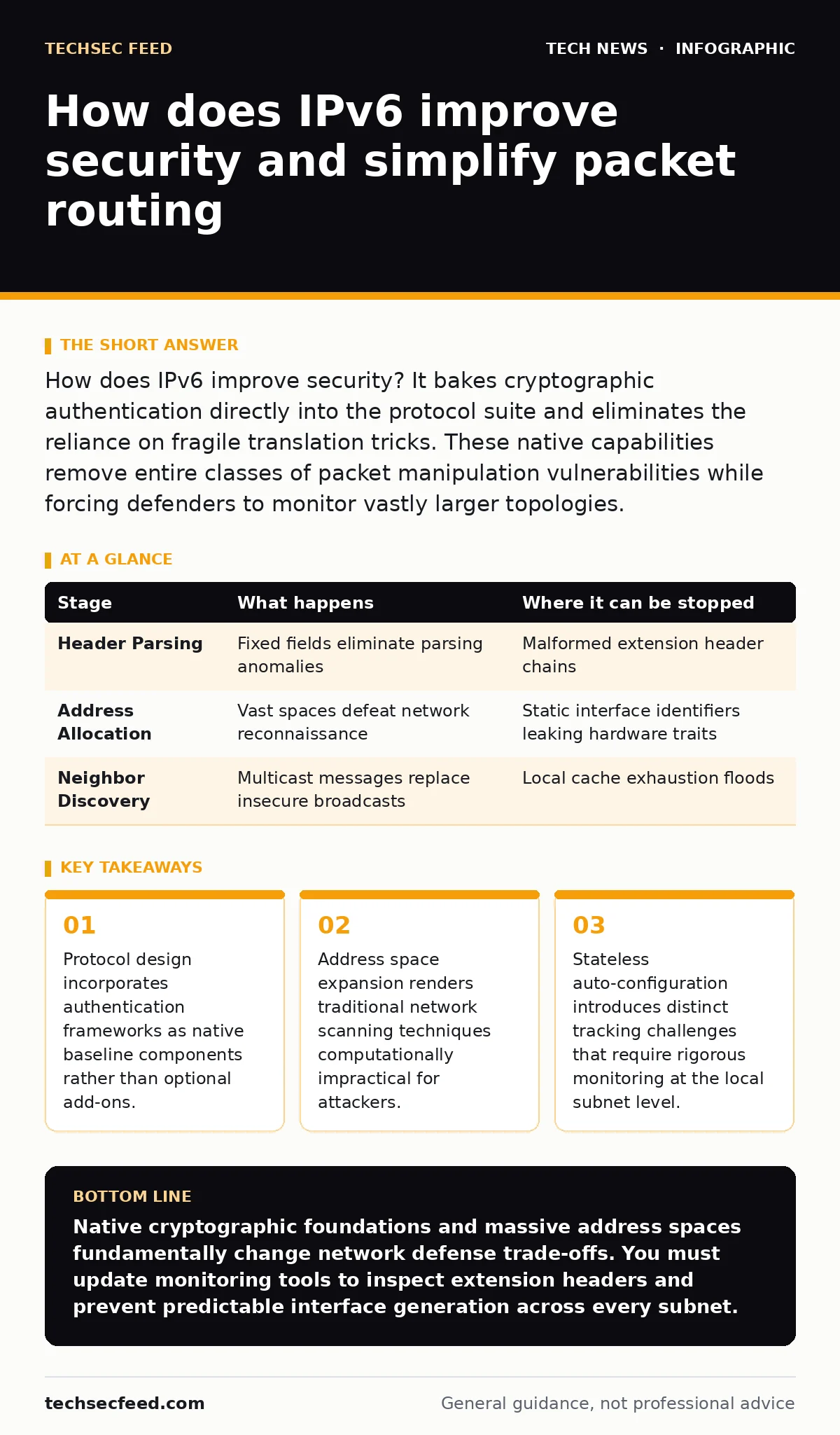
| Stage | What happens | Where it can be stopped |
|---|---|---|
| Header Parsing | Fixed fields eliminate parsing anomalies | Malformed extension header chains |
| Address Allocation | Vast spaces defeat network reconnaissance | Static interface identifiers leaking hardware traits |
| Neighbor Discovery | Multicast messages replace insecure broadcasts | Local cache exhaustion floods |
See also: Remote Access Control System: How It Works and What You Miss · ASN Threat Intelligence: Small Business Network Defense
Where legacy assumptions break down
Dual-stack environments operating both protocols simultaneously create blind spots where defenders often apply outdated security policies to modern traffic streams. You must secure both protocol layers independently because an airtight perimeter on one side provides zero protection if the alternate path remains unmonitored. Firewalls configured to inspect legacy traffic frequently drop or misinterpret valid extension headers, inadvertently breaking legitimate communications or letting malicious payloads slip past unchecked.
Key takeaways
- Protocol design incorporates authentication frameworks as native baseline components rather than optional add-ons.
- Address space expansion renders traditional network scanning techniques computationally impractical for attackers.
- Stateless auto-configuration introduces distinct tracking challenges that require rigorous monitoring at the local subnet level.
Native cryptographic foundations and massive address spaces fundamentally change network defense trade-offs. You must update monitoring tools to inspect extension headers and prevent predictable interface generation across every subnet.
Frequently asked questions
Does IPv6 completely replace the need for firewalls?
No, encryption and large address spaces stop reconnaissance and eavesdropping, but firewalls remain necessary to enforce application-layer access controls.
Why do security scanners struggle with modern subnets?
The vast scale of available addresses renders traditional brute-force ping sweeps computationally infeasible for discovering active hosts.
Can attackers still spoof addresses on local segments?
Cryptographically generated addresses prevent spoofing, but misconfigured hosts using hardware-derived identifiers remain vulnerable to local impersonation.
How do extension headers affect network performance?
Fixed base headers speed up routing, but long chains of extension headers can slow down deep packet inspection if security devices lack hardware acceleration.
How this guide was produced: written by the TechSec Feed editorial team with AI assistance, checked against the public references listed below, and reviewed when the facts change. See our editorial policy or report an error.