
Operating system kernel architecture and how memory isolation fails
Operating system kernel architecture grants total hardware control, yet a single logic flaw in ring zero compromises every running process instantly.
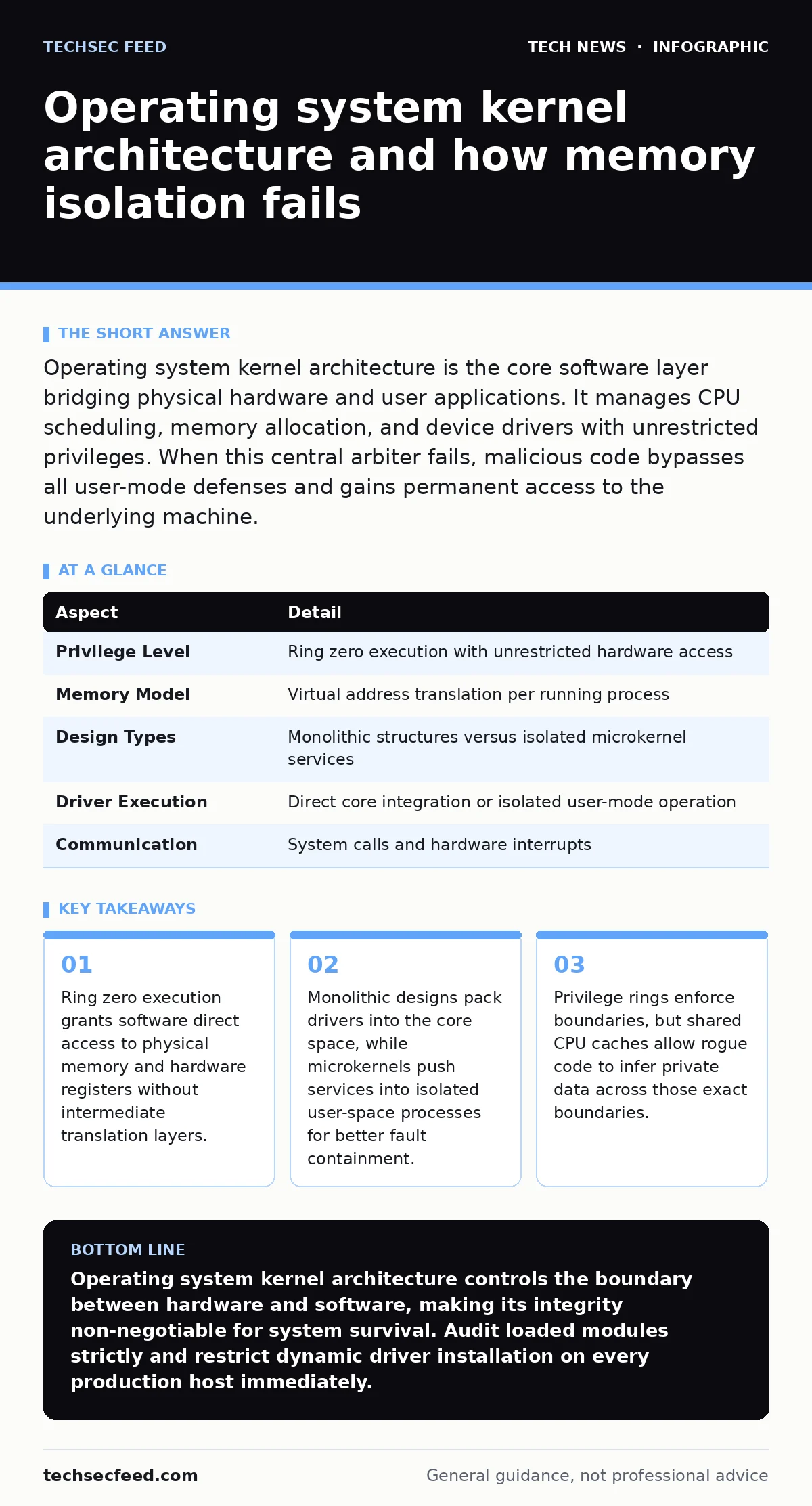
Operating system kernel architecture is the core software layer bridging physical hardware and user applications. It manages CPU scheduling, memory allocation, and device drivers with unrestricted privileges. When this central arbiter fails, malicious code bypasses all user-mode defenses and gains permanent access to the underlying machine.
The central bridge of digital machinery
Operating system kernel architecture acts like the head chef in a chaotic restaurant kitchen, managing raw ingredients and station assignments while keeping the cooks separated. This low-level software forms the absolute foundation of computer operations, sitting directly between physical hardware components and user-facing software applications.
Physical hardware components require precise voltage timing and register manipulation to function correctly. Raw hardware management is far too complex for standard text editors or web browsers to handle directly. The core software layer abstracts these physical details into clean interfaces, allowing multiple programs to share the same processor and memory banks without colliding.
How the core controls execution
Processor hardware enforces strict privilege boundaries, typically dividing operations into distinct rings of trust. User applications run in restricted execution modes where direct hardware manipulation triggers an immediate hardware fault. The core software operates inside the most privileged execution level, possessing absolute authority over every connected device and memory address.
System calls serve as the regulated doorways between restricted user applications and privileged core services. When a program needs to read a file or send network packets, it triggers a software interrupt that pauses its own execution and hands control to the central arbiter. The core validates the request parameters, performs the requested hardware action on behalf of the application, and returns the result safely.
| Aspect | Detail |
|---|---|
| Privilege Level | Ring zero execution with unrestricted hardware access |
| Memory Model | Virtual address translation per running process |
| Design Types | Monolithic structures versus isolated microkernel services |
| Driver Execution | Direct core integration or isolated user-mode operation |
| Communication | System calls and hardware interrupts |
Monolithic designs bundle file systems, network stacks, and hardware drivers into a single massive binary running in privileged space. This tight coupling yields high execution speed because components communicate through direct function calls. A memory corruption bug inside any single driver, however, crashes the entire operating system instantly.
Microkernel designs minimize the trusted code base by pushing file systems and device drivers out into unprivileged user space. Inter-process communication channels handle message passing between these isolated services when applications request resources. This compartmentalization prevents a failing driver from halting the entire machine, trading raw execution speed for greater fault tolerance.
Who faces kernel architecture risks
Every organization running standard computing hardware relies heavily on these low-level software abstractions. Enterprise server farms, desktop workstations, and cloud infrastructure nodes depend on reliable memory management to keep workloads isolated from one another.
Multi-tenant cloud environments push this architecture to its absolute limits by packing unrelated customer workloads onto identical physical hardware. Virtualization layers attempt to isolate these guests, but underlying core code flaws allow malicious software to escape virtual boundaries and compromise the hypervisor itself.
Hardware manufacturers continually introduce performance enhancements that inadvertently complicate software isolation models. Complex branch prediction logic and speculative execution optimization paths allow malicious user-mode code to measure microarchitectural timing differences. These side-channel leaks let processes reconstruct data from protected memory regions, completely bypassing traditional access control lists.
What people usually get wrong
Security teams frequently assume that patching user-space applications adequately protects a host from compromise. Core-level vulnerabilities require distinct remediation strategies because standard endpoint detection tools often lack visibility into privileged memory spaces.
Another common misconception involves trusting modular device drivers implicitly simply because they load during the boot sequence. Monolithic cores treat all loaded modules as equally trustworthy, meaning a poorly written printer driver possesses the exact same hardware privileges as the core scheduler itself.
Hardening low-level system defenses
Auditing core configurations requires deep inspection of loaded kernel modules and active memory protection flags. Production systems should restrict dynamic module loading to prevent unauthorized software from injecting malicious code directly into privileged execution rings.
Modern operating systems implement control flow integrity checks to prevent attackers from hijacking function pointers within privileged memory. These mitigations ensure that execution paths follow predetermined graphs, blocking return-oriented programming attacks that chain existing code snippets together to bypass security controls.
Organizations must also account for hardware-level security constraints when integrating protocols like IPv6 security across enterprise network boundaries. Low-level packet inspection routines process heavy traffic volumes inside privileged memory contexts, making network stack efficiency a critical factor in overall system stability.
Key takeaways
- Ring zero execution grants software direct access to physical memory and hardware registers without intermediate translation layers.
- Monolithic designs pack drivers into the core space, while microkernels push services into isolated user-space processes for better fault containment.
- Privilege rings enforce boundaries, but shared CPU caches allow rogue code to infer private data across those exact boundaries.
Operating system kernel architecture controls the boundary between hardware and software, making its integrity non-negotiable for system survival. Audit loaded modules strictly and restrict dynamic driver installation on every production host immediately.
Frequently asked questions
Can a non-privileged user process modify kernel memory directly?
User processes run in restricted execution modes and cannot touch privileged memory without triggering an immediate hardware fault. Virtual memory mapping keeps application address spaces completely isolated from core execution structures.
Why do microkernels run drivers in user space?
Microkernels isolate drivers into separate processes so that a driver crash does not bring down the entire operating system. This design trades a small performance overhead for significantly higher fault containment.
What happens when a system call executes?
A system call triggers a controlled CPU mode switch from unprivileged user space to privileged core execution. The operating system validates the request parameters before performing the requested hardware action.
How do speculative execution flaws affect operating system kernels?
Speculative execution optimization features allow processors to guess future instruction paths and leave microscopic traces in hardware caches. Rogue software measures these timing traces to read protected memory data across isolation boundaries.
How this guide was produced: written by the TechSec Feed editorial team with AI assistance, checked against the public references listed below, and reviewed when the facts change. See our editorial policy or report an error.