
RSA Encryption Explained: How Public and Private Keys Work
See how asymmetric cryptography secures your data using a lockbox analogy that clarifies why you never share your secret key.
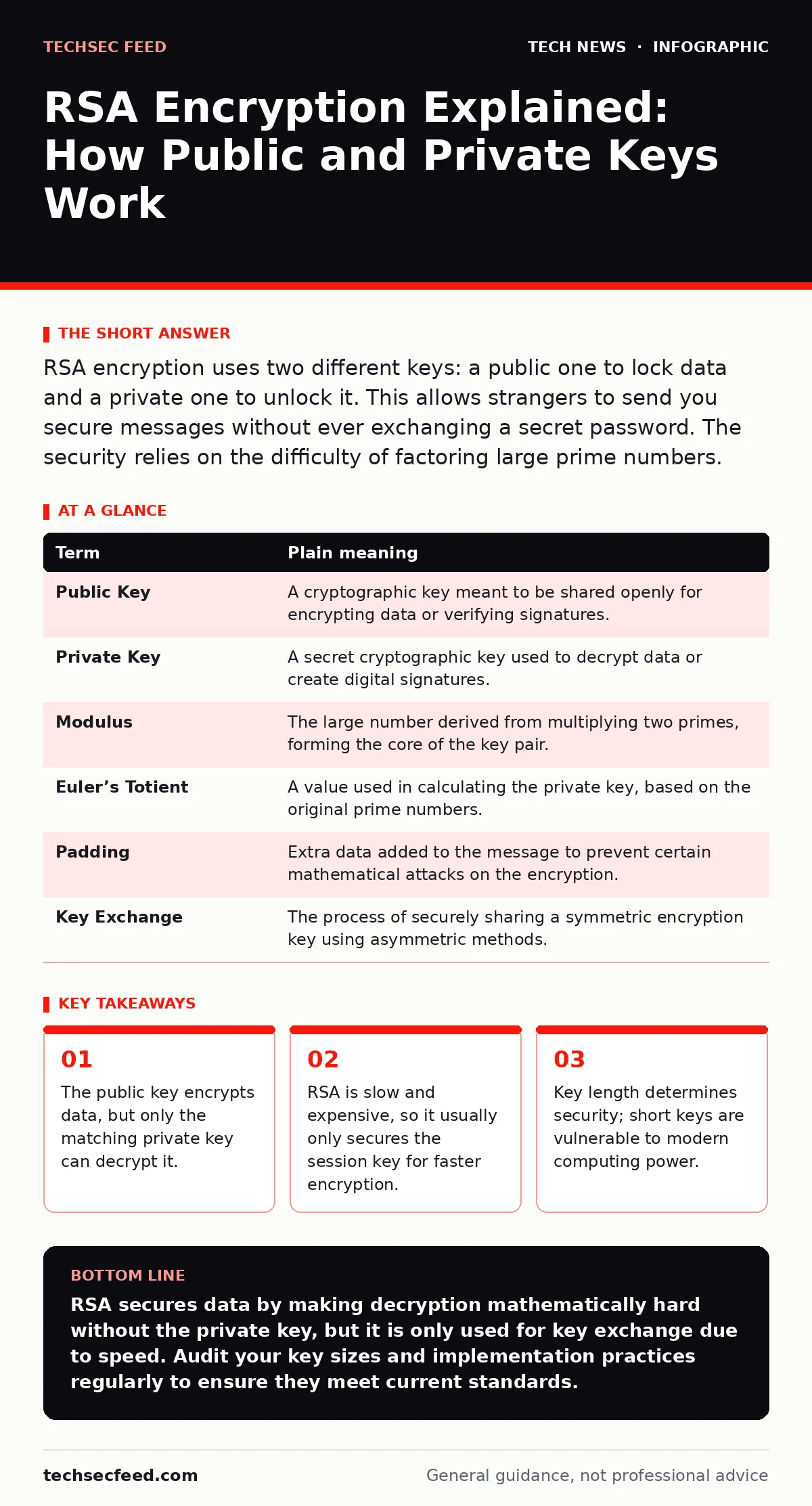
RSA encryption uses two different keys: a public one to lock data and a private one to unlock it. This allows strangers to send you secure messages without ever exchanging a secret password. The security relies on the difficulty of factoring large prime numbers.
The Mailbox Analogy
Imagine a mailbox with a slot that anyone can use to drop letters inside. You keep the only key that opens the box. Anyone in the world can put a message in the slot, but only you can retrieve it. This is how asymmetric cryptography works. It solves the problem of sharing secrets over insecure channels. You do not need to meet someone in person to agree on a secret code. You simply give them your public slot, and they send you an encrypted message.
In this system, the mailbox slot is your public key. It is designed to be shared openly. The key that opens the box is your private key. It must remain secret. If someone steals the private key, they can read every message sent to you. The security does not come from hiding the slot. It comes from the mathematical relationship between the lock and the key.
The Math Behind the Lock
RSA relies on the properties of prime numbers. A prime number is a number greater than one that has no divisors other than one and itself. Multiplying two large prime numbers is easy for a computer. Reversing the process, known as factorization, is extremely difficult. The security of RSA rests on this asymmetry. An attacker with your public key sees the product of two primes. They cannot easily determine the original primes without immense computational effort.
This difficulty creates a one-way function. You can move forward through the math quickly. Moving backward takes an impractical amount of time. As computing power increases, the primes must get larger. This is why key sizes have grown over time. A key that was secure a decade ago may now be breakable. You must use sufficiently large keys to maintain safety.
Common Points of Confusion
Many people assume RSA encrypts entire files. It does not. RSA is computationally expensive. Encrypting a large document with RSA would take forever. Instead, RSA is used to exchange a symmetric key. Symmetric encryption uses the same key for locking and unlocking. It is fast but requires secure key distribution. RSA solves the distribution problem. It securely delivers the symmetric key to the recipient. The symmetric key then encrypts the actual data.
Another confusion involves digital signatures. Signing is not the same as encrypting. When you sign a document, you use your private key to create a unique hash. Anyone with your public key can verify the signature. This proves you created the document. It does not hide the content. Encryption hides the content. Signing proves the source. They are often used together, but they serve different purposes. Do not mix up the direction of the keys.
The Mini Glossary
| Term | Plain meaning |
|---|---|
| Public Key | A cryptographic key meant to be shared openly for encrypting data or verifying signatures. |
| Private Key | A secret cryptographic key used to decrypt data or create digital signatures. |
| Modulus | The large number derived from multiplying two primes, forming the core of the key pair. |
| Euler’s Totient | A value used in calculating the private key, based on the original prime numbers. |
| Padding | Extra data added to the message to prevent certain mathematical attacks on the encryption. |
| Key Exchange | The process of securely sharing a symmetric encryption key using asymmetric methods. |
Why RSA Is Not Always the Answer
RSA has inherent limitations. It is slower than symmetric algorithms like AES. Using it for bulk data encryption wastes resources. It also requires careful implementation. Poor random number generation can weaken the primes. If the primes are not truly random, attackers can predict them. This is a silent failure. The encryption appears to work, but the security is an illusion.
Quantum computing poses a future threat. Quantum algorithms can factor large numbers much faster than classical computers. This could break RSA entirely. While practical quantum computers are not yet widespread, the threat is real. Organizations are preparing for this shift. They are exploring post-quantum cryptography. These new methods rely on different mathematical problems. You should plan for a transition away from RSA in the long term.
Try This Now
- Generate a key pair using a trusted tool like OpenSSL. Inspect the public and private components to see their structure.
- Encrypt a short message with the public key. Attempt to decrypt it with the wrong private key to see the failure.
- Verify a digital signature using the public key. Change one character in the signed message and watch the verification fail.
The Hidden Cost of Trust
RSA assumes the private key is secure. It does not protect against social engineering. If an attacker tricks you into revealing your private key, the math is irrelevant. The system is broken. This is the human element. Technology can only secure what you protect. You must safeguard your keys with the same rigor as physical cash.
Also, consider the trust chain. You trust that the public key belongs to the person you think it does. This is often verified by a Certificate Authority. If the authority is compromised, the trust is broken. You are trusting a third party to vouch for identities. This introduces a central point of failure. Decentralized models like Web of Trust attempt to solve this, but they have their own complexities.
Key takeaways
- The public key encrypts data, but only the matching private key can decrypt it.
- RSA is slow and expensive, so it usually only secures the session key for faster encryption.
- Key length determines security; short keys are vulnerable to modern computing power.
RSA secures data by making decryption mathematically hard without the private key, but it is only used for key exchange due to speed. Audit your key sizes and implementation practices regularly to ensure they meet current standards.
Frequently asked questions
Is RSA encryption secure against all attacks?
No, RSA is vulnerable to quantum computing attacks and implementation errors. It also requires sufficiently large key sizes to resist classical factorization.
How is RSA different from AES encryption?
RSA is asymmetric, using two keys, and is slow. AES is symmetric, using one key, and is fast. RSA typically secures the AES key during exchange.
What happens if I lose my private key?
You cannot decrypt any data encrypted with your public key. The data is permanently inaccessible. You must back up your private keys securely.
Do I need RSA for personal email?
Modern email protocols like TLS use RSA or similar algorithms for the initial handshake. You do not need to manage keys manually for standard email use.
How this guide was produced: written by the TechSec Feed editorial team with AI assistance, checked against the public references listed below, and reviewed when the facts change. See our editorial policy or report an error.