OSI Model Misconceptions: What Network Engineers Actually Use
The OSI model is a pedagogical abstraction that rarely maps to modern packet flows, yet teams waste hours debugging by forcing reality into its seven rigid layers.
The OSI model is a teaching tool, not a design blueprint. Modern protocols like HTTPS and TLS blur layer boundaries, making strict layer isolation a myth. Use it to categorize concepts, not to dictate architecture or troubleshoot complex, cross-layer failures.
Misreading: The layers map to physical hardware components
Many engineers assume that Layer 1 corresponds to cables, Layer 2 to switches, and Layer 3 to routers. This physical mapping is a convenient shorthand that breaks down immediately in modern data centers. A single network interface card may handle physical signaling, frame construction, and IP routing offloading simultaneously.
Correct reading: The layers describe logical functions, not physical devices. A device can perform functions across multiple layers, or a single layer’s functions can be distributed across multiple hardware components. Focus on what the code or firmware is doing, not where the chip sits.
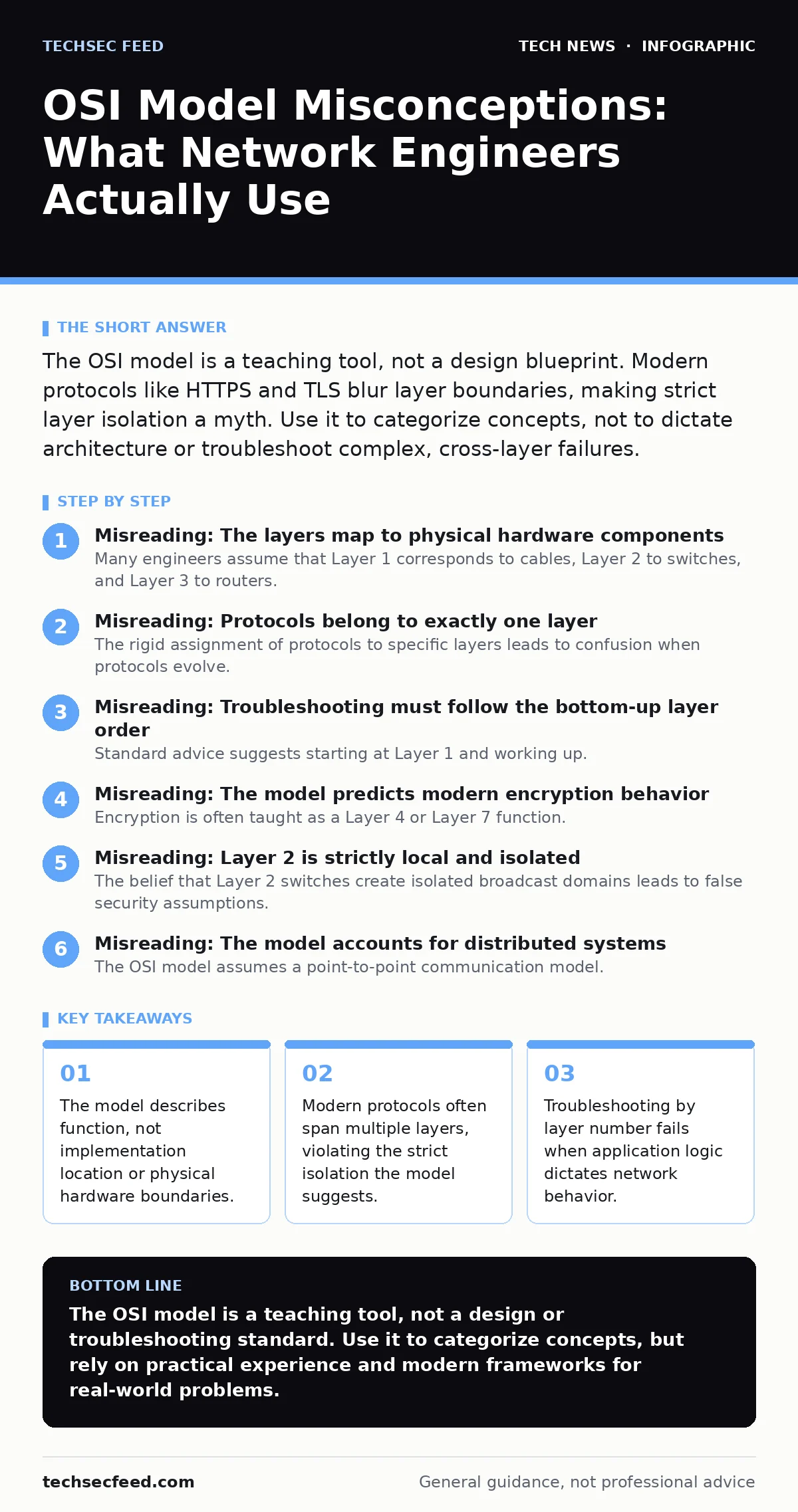
Misreading: Protocols belong to exactly one layer
The rigid assignment of protocols to specific layers leads to confusion when protocols evolve. For instance, you might classify DNS strictly as an Application Layer protocol. However, DNS resolution often involves transport mechanisms that behave differently depending on whether you use TCP or UDP.
Correct reading: Protocols are defined by their function, not their layer number. A single protocol stack may exhibit characteristics of multiple layers. When analyzing traffic, look at the encapsulation headers. If a protocol handles reliability, it touches the Transport Layer, regardless of its primary application purpose.
Misreading: Troubleshooting must follow the bottom-up layer order
Standard advice suggests starting at Layer 1 and working up. This linear approach assumes that lower layers are the most likely point of failure. In reality, application logic errors often manifest as network timeouts or dropped packets.
Correct reading: Start where the symptom is observed. If an application fails to connect, checking the physical cable is often a waste of time. The error may lie in certificate validation or DNS resolution. Use the model to narrow the scope, not to enforce a rigid diagnostic sequence. See how this applies to secure software development practices.
Misreading: The model predicts modern encryption behavior
Encryption is often taught as a Layer 4 or Layer 7 function. This distinction matters less than the implementation details. When you use HTTPS, the encryption happens at the application layer, but the handshake involves transport layer parameters.
Correct reading: Encryption boundaries are defined by the protocol, not the OSI model. TLS operates above the transport layer but below the application data. Understanding this helps you grasp why HTTPS traffic looks different from HTTP. For deeper context, review our guide on HTTPS implementation details.
Misreading: Layer 2 is strictly local and isolated
The belief that Layer 2 switches create isolated broadcast domains leads to false security assumptions. VLANs can be manipulated, and MAC address spoofing allows devices to bypass local segmentation.
Correct reading: Layer 2 mechanisms are vulnerable to manipulation. Trust boundaries must be enforced at higher layers or through strict access control lists. Assume that any device on the same broadcast domain can see unencrypted traffic. This is why IPv6 security requires additional controls beyond simple subnetting.
Misreading: The model accounts for distributed systems
The OSI model assumes a point-to-point communication model. It does not account for microservices, serverless functions, or distributed databases. These modern architectures introduce latency and failure modes that do not fit into seven neat boxes.
Correct reading: The model is too simplistic for modern cloud architectures. Use it to understand basic networking concepts, but rely on distributed systems theory for architecture design. The model does not help you debug a failed API call between two cloud regions.
Misreading: Higher layers are always dependent on lower layers
The model suggests a strict dependency chain. In practice, higher layers can often compensate for lower layer issues. For example, application-level retries can mask intermittent packet loss.
Correct reading: Dependencies are not absolute. Modern applications implement their own reliability mechanisms. This can hide underlying network issues, making diagnosis harder. Do not assume that a working application means a healthy network.
Misreading: The model is a design standard
This leads to rigid, inefficient systems that struggle to adapt to new protocols.
Correct reading: The model is a reference, not a rulebook. Design for functionality and performance. Use the model to communicate concepts, not to constrain your architecture. Flexibility is more valuable than theoretical purity.
Misreading: The model explains all network behavior
The OSI model ignores many real-world factors, such as caching, content delivery networks, and load balancing. These technologies operate outside the traditional seven-layer framework.
Correct reading: The model is incomplete. Use it as a starting point for learning, but supplement it with knowledge of modern infrastructure. Understanding how CDNs work requires looking beyond the OSI model.
Key takeaways
- The model describes function, not implementation location or physical hardware boundaries.
- Modern protocols often span multiple layers, violating the strict isolation the model suggests.
- Troubleshooting by layer number fails when application logic dictates network behavior.
The OSI model is a teaching tool, not a design or troubleshooting standard. Use it to categorize concepts, but rely on practical experience and modern frameworks for real-world problems.
Frequently asked questions
Should I use the TCP/IP model instead?
The TCP/IP model is more aligned with modern internet protocols. Use it for practical networking tasks, but keep the OSI model for conceptual clarity.
How does the OSI model relate to security?
It helps categorize attack vectors by layer. However, security controls must be applied across all layers, as attacks often span multiple layers.
Can I ignore the OSI model entirely?
You can ignore it for design, but you should understand it for communication. It is a common language for discussing networking concepts.
How this guide was produced: written by the TechSec Feed editorial team with AI assistance, checked against the public references listed below, and reviewed when the facts change. See our editorial policy or report an error.